



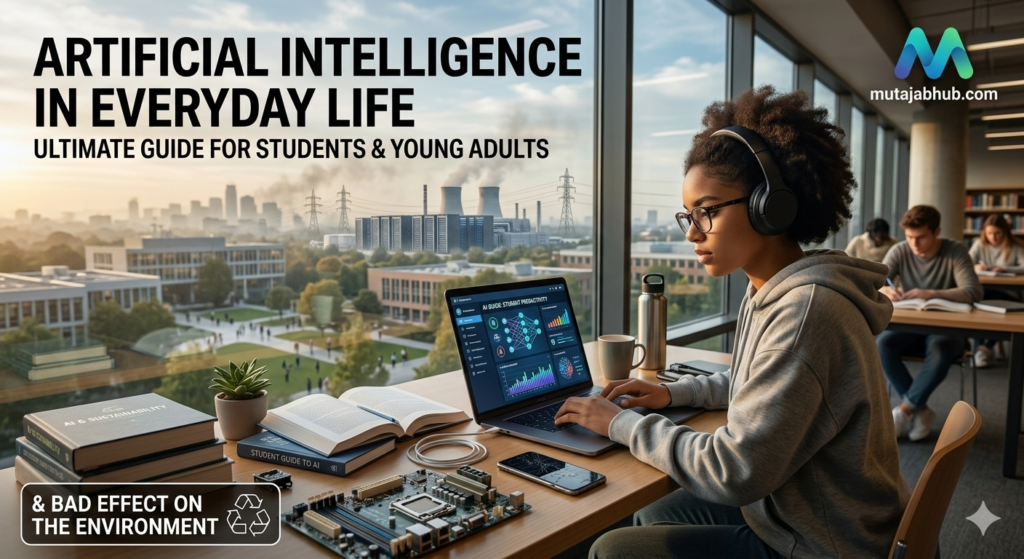
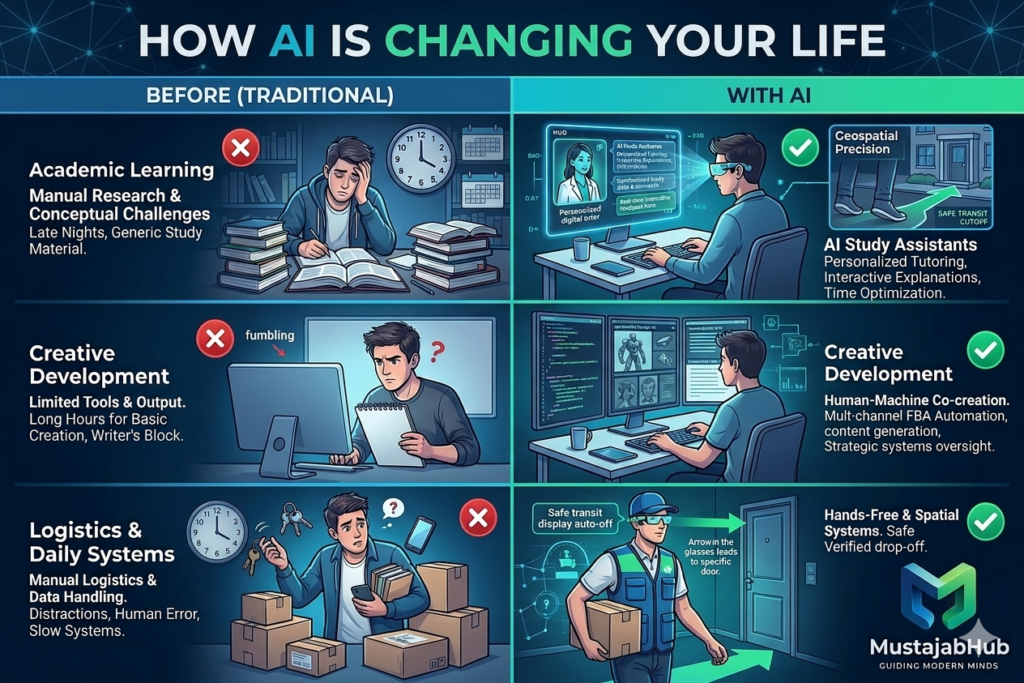
Artificial intelligence in everyday life is no longer a futuristic concept reserved for science fiction movies or high-tech research laboratories. It is actively re-architecting how we learn, communicate, work, and make decisions. Think back to how students operated just a decade ago. Researching a paper required hours of manual filtering through physical library stacks or cross-referencing dozens of static web pages. Getting stuck on a complex calculus formula or a challenging piece of code at midnight meant waiting days for office hours or peer tutoring.
Those structural bottlenecks have fundamentally vanished. The democratization of generative technology has placed supercomputing power directly into the hands of anyone with an internet connection. This comprehensive guide breaks down exactly how these systems function, analyzes the tangible impacts on your academic and professional trajectories, provides real-world success data, and outlines a practical blueprint to make this technological shift work for your personal development.
Table of Contents
The Current State of Artificial Intelligence in Everyday Life
Let’s look past the marketing buzzwords and examine your existing daily patterns. You are likely interacting with advanced algorithmic networks dozens of times a day without consciously labeling them as automation. When your streaming platform queues up a highly specific cinematic recommendation, when your social media feed organizes content based on your scrolling speed, or when your smartphone accurately predicts your next three words via predictive text, you are witnessing machine learning in real-time.
[Wake Up: Adaptive Sleep Tracker] ➔ [Commute: Real-Time Traffic Routing] ➔ [Study: Semantic Retrieval Engines] ➔ [Work: Contextual Communication Monitors]
Consider a typical morning routine. Your alarm application utilizes sensory inputs to wake you up during your lightest sleep cycle. Your weather application processes millions of meteorological data points to predict down-to-the-minute precipitation changes. Your transit app synthesizes live geographical positioning coordinates from thousands of active vehicles to calculate the absolute fastest route to your university campus.
Understanding this system today is equivalent to mastering fundamental computer literacy or basic internet search mechanics at the turn of the millennium. The early adopters who recognized how to navigate digital search engines built the dominant enterprises of the modern era. You do not need a degree in data science or computer engineering to profit from this shift. You simply need to understand the practical frameworks, operational workflows, and strategic prompt structures that drive successful human-machine collaboration.
The Birth and Evolution of Artificial Intelligence
The roots of artificial intelligence trace back to British mathematician Alan Turing, who famously asked if machines could think in 1950. However, the official birth of AI occurred in 1956 during the Dartmouth Summer Research Project. Computer scientist John McCarthy coined the term “Artificial Intelligence” at this historic workshop, working alongside tech pioneers like Marvin Minsky and Herbert Simon. They envisioned machines that could simulate human intellect, process natural language, and solve complex problems, establishing the bedrock for modern computer science.
Today, artificial intelligence grows at an exponential rate, transforming from rigid, rule-based software into dynamic deep learning neural networks. The explosive rise of big data, cloud computing, and advanced graphics processing units (GPUs) fuels this daily expansion. Modern algorithms analyze massive data streams in real-time, allowing tools like automated predictive analytics, computer vision, and large language models (LLMs) to constantly evolve. As these autonomous systems integrate into healthcare, corporate finance, and search engine algorithms, AI adapts and optimizes by learning from human inputs every single second.
Essential AI Tool Ecosystems for Modern Learners
To maximize your academic efficiency, you must move past using web platforms as simple answer generators and start using them as comprehensive cognitive partners. Below is a detailed breakdown of the dominant tool categories changing the educational sector.
1. Interactive Study Assistants and Iterative Dialogue Engines
The old model of learning relied on uniform, one-size-fits-all textbooks. If an explanation did not click with your personal learning style, you were left behind. Modern large language models act as infinitely patient, hyper-customized private instructors. They don’t just give you raw data; they adapt their explanations to your exact level of understanding.
Take the case of a student named Riya, who was consistently failing her introductory organic chemistry course. Rather than using platforms to copy answers for her weekly assignments, she used an interactive study assistant to break down complex molecular orbital configurations. She used precise contextual prompts, such as:
“Act as an elite academic chemistry tutor. Break down the mechanism of electrophilic aromatic substitution into five sequential, highly visual steps. Do not give me the final answer to my homework problem. Instead, quiz me on each step of the mechanism, wait for my response, diagnose my logical errors, and provide real-world mechanical analogies until I master the underlying physics.”
By transforming a passive web interface into an active Socratic dialogue partner, Riya reframed her conceptual baseline. Within eight weeks, her exam scores advanced from a failing average to an verified 85%. The technology did not replace her effort—it targeted her cognitive gaps with extreme precision.
2. Contextual Writing Optimization and Syntax Refining Engines
The process of drafting academic literature, technical engineering reports, or long-form analysis has shifted from simple spelling corrections to deep semantic refinement. Legacy tools only identified basic typos. Modern writing helpers analyze structural clarity, tone consistency, and arguments.
Platforms like Grammarly utilize sophisticated contextual processing networks to evaluate whether your thesis statement matches your supporting paragraphs. These systems flag passive voice usage, highlight repetitive vocabulary patterns, and suggest structural rearrangements to maximize reading comprehension. The goal is not to let a machine write your assignments, but to use these suggestions to sharpen your personal voice and communicate your ideas with maximum clarity.
3. Adaptive Micro-Learning and Language Acquisition Networks
Learning a secondary language has historically suffered from high attrition rates due to boring memorization routines and expensive private tutoring options. Modern educational platforms have solved this by using real-time spacing algorithms that adapt perfectly to student performance.
Ecosystems like Duolingo process billions of daily user inputs to determine exactly when a specific user is likely to forget a newly acquired vocabulary term. If you consistently struggle with specific past-tense verb conjugations but master noun genders instantly, the underlying engine dynamically alters your upcoming lesson structure. It delivers targeted practice modules exactly when your brain requires reinforcement. This provides an individualized learning track that was historically unavailable to mass-market students.
Comprehensive Educational Tool Comparison Matrix
| Platform System | Primary Utility Metric | Contextual Window Capabilities | Optimal Prompt Strategy |
| Advanced LLMs (e.g., ChatGPT, Claude) | Conceptual translation, Socratic debugging, code analysis | Deep multi-page structural synthesis | Multi-turn role-playing with strict logical constraints |
| Syntax Refiners (e.g., Grammarly) | Structural clarity improvement, tone modulation, grammar auditing | Paragraph-level contextual evaluation | Inline stylistic adjustments based on targeted reader demographics |
| Adaptive Learning Systems | Micro-learning progression, targeted vocabulary retention | Long-term memory profile tracking | Programmatic interaction via short, daily gamified testing intervals |
Analyzing the Evolving Professional Architecture and Workforce Metrics
A common concern among young adults entering the workforce is the shifting nature of employment. The job market is changing rapidly, but this evolution is creating a wide range of new opportunities for early-career professionals. The critical shift is away from repetitive information management and toward strategic systems oversight.
[Legacy Professional: Manual Data Entry & Processing]
                     ▼
[Modern Professional: Algorithmic Systems Orchestration & Prompt Optimization]
According to macro-economic workplace reports published by institutions like the World Economic Forum, while automation is projected to phase out routine administrative roles, it is simultaneously on track to generate millions of net-new positions globally. These emerging disciplines require individuals who can bridge the gap between technical algorithmic capabilities and human-centric problem-solving.
The New Frontier of Specialized Careers
- Prompt Engineers and Context Optimization Architects: These specialists do not write raw code in languages like C++ or Python. Instead, they design, test, and refine high-level linguistic templates that guide enterprise systems to produce accurate, safe, and contextually rich outputs. This career path requires deep logical reasoning, strong communication skills, and clear analytical thinking.
- Algorithmic Content Auditors and System Safety Mediators: As businesses deploy consumer-facing automation models at scale, protecting brand integrity and ensuring safety are paramount. These professionals analyze automated outputs for logical fallacies, data hallucinations, and compliance issues, ensuring that the systems operate reliably and ethically.
- Dataset Curation and Validation Specialists: Machine learning engines are entirely dependent on the quality of their training data. Curation specialists source, clean, organize, and label highly specialized information repositories, building the foundation that allows specialized industries—such as healthcare and legal services—to build accurate models.
- Digital Wellness Architects and Workflow Optimization Consultants: As automation accelerates the speed of business communications, organizations face employee burnout and digital clutter. Wellness architects design sustainable balance strategies, helping teams integrate productivity software without compromising mental health or long-term creativity.
The core competitive advantage for current students is having grown up alongside these digital systems. This familiarity gives you an intuitive understanding of user experience patterns that older legacy workers often take years to develop.
Demystifying Machine Learning Architecture for Beginners
To confidently manage these systems, you must demystify how they actually function. At its core, machine learning is not sentient or conscious; it is an incredibly advanced pattern recognition framework.
Imagine training a child to recognize a canine. You do not hand the child a complex biological textbook detailing genetic sequences. Instead, you show them thousands of real-world examples: big dogs, miniature dogs, long-haired retrievers, and short-haired terriers. Over time, the child’s brain inherently identifies the unifying visual patterns—such as ear structure, snout proportions, and movement dynamics—that differentiate a dog from a cat or a fox.
[Massive Training Datasets] ➔ [Pattern Identification Protocols] ➔ [Probabilistic Prediction Models]
Modern software engines operate on this exact principle, scaled up by massive computational clusters. When a social media platform correctly identifies a friend’s face in a newly uploaded photograph, it isn’t “thinking.” It is running a probabilistic calculation across millions of pixel values, matching vector coordinates with previously verified image assets. It is pattern matching at an unprecedented scale.
Consider a simple game of twenty questions, where you attempt to guess an object using only yes-or-no prompts. A human might take several turns to narrow down the category. An advanced machine learning model asks millions of simultaneous micro-questions across a massive probability matrix in fractions of a second. It handles massive amounts of data to provide highly accurate, contextual outputs.
Data Governance, System Security, and Critical Thinking
Operating safely in this digital age requires moving past uncritical acceptance and adopting a structured, zero-trust validation approach. As these platforms grow more powerful, the responsibility for maintaining data privacy and verifying factual accuracy falls squarely on the user.
1. The Strategy of Absolute Vector Privacy
Every piece of text, code, or personal data you enter into a public software interface is often processed to train future iterations of that model. Never upload unencrypted financial statements, proprietary source code, or highly sensitive personal identification documents to public servers. Always review the data settings of your tools, opt out of automated training loops, and read user privacy agreements thoroughly. Treat public software systems like a conversation with a helpful acquaintance: share the conceptual problem, but keep your private data secure.
2. Systematic Factual Auditing and Hallucination Mitigations
These systems operate on probabilistic next-token predictions, which means they are optimized for linguistic fluency rather than absolute factual correctness. A model can draft a beautifully structured, highly convincing essay that contains completely fabricated historical dates, non-existent scientific citations, or flawed mathematical logic. This phenomenon is known as data hallucination.
You must treat automated outputs as unverified first drafts. Always cross-reference core historical facts, legal precedents, and medical claims against trusted primary databases and authoritative academic literature.
3. Preserving and Enhancing Your Human Capabilities
The ultimate danger of modern automation is cognitive atrophy. If you let software handle all your writing, basic coding, and critical analysis, your personal ability to problem-solve will decline over time.
Use these tools to accelerate your research and explore creative ideas, but continue to sketch out conceptual diagrams by hand, read long-form print literature, and solve foundational problems independently. The highly successful professionals of the future will not be those who rely blindly on automated systems, but those who combine sharp human intuition with tool execution.
Roadmap to System Mastery: A 30-Day Sprint
If you want to transition from a passive user to an expert systems manager, you need a structured approach. Avoid trying to learn everything at once. Instead, follow this structured four-week implementation framework:
[Week 1: Cross-Platform Auditing] ➔ [Week 2: Advanced Interaction Frameworks] ➔ [Week 3: Practical Project Execution] ➔ [Week 4: Advanced Systems Integration]
Week 1: Cross-Platform Auditing and Tactical Exploration
- Dedicate 15 minutes each day to exploring three distinct generative tool ecosystems.
- Experiment with a text engine to summarize a long academic paper, use a generative image tool to build visual concepts, and test an audio system to generate a custom backing track for a project.
- Focus on discovering what these tools can and cannot do well.
Week 2: Advanced Interaction Frameworks and Analytical Concepts
- Study the foundational mechanics of prompt architecture. Move past simple, single-sentence inputs and learn how to construct structured prompts that define a clear role, outline explicit constraints, specify the target audience, and set the exact output format.
- Watch clear educational videos detailing the historical transition from traditional programming to modern machine learning models.
- Identify and join professional digital communities focused on using these tools for educational and career advancement.
Week 3: Practical Project Execution and Problem Solving
- Select one tangible problem in your life or studies and use an automated tool to help solve it.
- If you are learning a programming language, use a conversational model to audit your code line-by-line and explain your bugs. If you are launching a student organization, use a text tool to help build a comprehensive project timeline.
- Share your operational workflows and prompt discoveries with peers to test your approach.
Week 4: Advanced Systems Integration and Long-Term Career Mapping
- Analyze your long-term career goals and identify the specific automation tools shaping that industry.
- Enroll in verified, free foundational courses offered by leading institutions, such as the open learning initiatives from MIT or major technology providers.
- Optimize your professional digital profiles by highlighting your practical experience in human-machine collaboration and automated workflow design.
Historical Tech Shifts and the Power of Adaptability
Whenever a major technological shift happens, the initial public reaction is often driven by worry and worst-case scenarios. When electronic calculators entered classrooms decades ago, critics claimed they would completely destroy students’ mathematical abilities. Instead, they freed students from tedious manual calculations, allowing educators to focus on teaching higher-level architectural principles and advanced engineering mathematics.
The exact same shift is happening with modern automation. While specific repetitive roles are changing, entirely new professional fields are opening up even faster. The definitive differentiator for your career is your willingness to learn and adapt. By combining unique human strengths—like emotional intelligence, deep empathy, and ethical critical thinking—with the speed and power of modern digital tools, you build a resilient professional skillset that is highly valued in the modern job market.
Real-World Case Studies of Practical Human-Machine Collaboration

Case Study 1: Scaling a Location-Independent Content Production Workflow
Consider Raj, a 22-year-old student living in a remote town. He wanted to launch a digital video production business but lacked the capital to hire a full team of copywriters, video editors, and research assistants. Instead of giving up on his goal, he built an automated content generation pipeline on his laptop.
[Raw Research Processing via LLM] ➔ [Structural Editing & Hook Optimization] ➔ [Visual Editing Automation Tools] ➔ [Final Human Editorial Control]
Raj used advanced language models to synthesize deep research reports on complex global topics in minutes. He then used writing helpers to optimize his video scripts for viewer retention, and integrated automated editing tools to handle time-consuming tasks like audio cleanup and caption generation. By acting as the strategic director of his automated system rather than a manual video editor, Raj built a highly competitive digital media agency from his home. He succeeded because he focused on creative direction while letting software handle the repetitive production tasks.

Case Study 2: Designing Accessible Learning Solutions for Diverse Needs
Sneha, a university sophomore, saw her younger brother struggle with traditional learning materials due to severe dyslexia. Standard textbooks failed to hold his attention, and personalized learning support was prohibitively expensive.
Sneha used custom prompting frameworks on generative text models to translate standard primary school curricula into highly engaging, interactive stories tailored to her brother’s specific interests. She used automated image generation tools to create vivid matching visual aids and turned those text modules into natural audio files using text-to-speech software.
Seeing how well this worked, she turned her personal workflow into a dedicated mobile application layout using clean, automated design tools. Today, her platform provides custom educational resources to thousands of students with diverse learning needs, showing how young adults can use these systems to solve real-world problems.
Actionable Resource Mapping and Navigating the Website Framework
To continue expanding your digital literacy and marketing skills, you must connect these concepts directly to actionable frameworks. If you are building a professional web presence to showcase your digital projects, explore the step-by-step technical blueprints in our Web Development Services Strategy.
Furthermore, to master the broader mechanics of digital platforms and educational systems, review our complete architectural breakdown in the Beginner’s Guide to Digital Education Hub. This hub provides the strategic foundations needed to turn basic software tools into scalable systems for long-term growth.
The Dark Side: Environmental and Social Disasters of AI
Despite its rapid progress, widespread AI adoption threatens human society and the planet’s ecological balance. In daily life, automated algorithms rapidly displace workers across both creative and technical industries, triggering widespread economic instability and shifting the job market too fast for workers to adapt. The unchecked rise of sophisticated deepfakes and automated misinformation campaigns actively erodes public trust and destabilizes global democratic systems. More critically, AI demands a devastating environmental price; massive data centers operating worldwide consume billions of gallons of freshwater for cooling and require immense electrical grids, accelerating carbon emissions and global warming. This digital expansion leaves behind an alarming trail of electronic waste and a planet struggling to power the very infrastructure built to replace human labor.

Frequently Asked Questions (FAQ)
How is artificial intelligence used in everyday life?
We interact with artificial intelligence in everyday life every time we unlock our smartphones. AI powers the predictive text on your keyboard, the real-time traffic updates on your GPS, the fraud detection alerts from your bank, and the hyper-personalized recommendation algorithms on Spotify and TikTok. It acts as an invisible background engine making daily digital tasks faster and more personalized.
What are the best free AI tools for students to study?
For conceptual learning and brainstorming, ChatGPT and Claude offer excellent free conversational tiers. If you want to streamline your academic research, tools like Consensus and Perplexity find verified scientific papers with real citations. For structural writing edits and grammar auditing, Grammarly remains the industry standard for polished essays.
Is using AI for school assignments considered cheating?
It depends entirely on how you use it. Using an AI tool to copy-paste full paragraphs or generate an entire essay is plagiarism and academic dishonesty. However, using AI as a Socratic study partner—asking it to explain a complex formula, brainstorm essay topics, or test your knowledge before an exam—is an elite learning strategy that teachers encourage.
Can I get an AI-related job if I don’t know how to code?
Yes, absolutely. The expanding tech landscape is generating thousands of entry-level AI job opportunities for beginners that do not require software engineering degrees. Roles like prompt engineers, AI content editors, dataset curators, and digital wellness trainers rely heavily on human logic, strong communication, and ethical analysis rather than raw coding skills.
How does machine learning work for beginners in simple terms?
Think of machine learning like training a puppy. Instead of writing strict rules for every single action, you show a computer system millions of examples of a specific pattern (like pictures of a cat). Over time, the system automatically learns to recognize the unifying features of a cat without a human explicitly defining them. It is advanced pattern recognition based on pure data trial and error.
How do I know if an AI tool is lying or hallucinating facts?
You assume every first draft from an AI engine contains errors. Because these tools predict the most likely next word rather than checking a live fact database, they can invent fake historical dates, non-existent book titles, or flawed math logic while sounding completely confident. Always cross-reference critical data points against verified primary sources, libraries, or academic journals.
How can I protect my privacy when using AI applications?
The golden rule is simple: never upload data to a public AI search engine that you wouldn’t post on a public social media page. Avoid inputting private financial statements, passwords, or highly personal journal entries. Go into your app settings, turn off “history and training sharing,” and actively opt out of letting companies use your conversations to train future software models.
Who officially invented artificial intelligence and when?
Computer scientist John McCarthy officially coined the term “Artificial Intelligence” in 1956 during the Dartmouth Summer Research Project. While British mathematician Alan Turing first laid the theoretical groundwork in 1950 by questioning if machines could think, McCarthy, alongside pioneers Marvin Minsky and Herbert Simon, formally launched AI as a distinct field of computer science during this historic summer workshop.
Why is artificial intelligence growing so fast right now?
The explosive growth of modern AI stems from a combination of massive big data accumulation, scalable cloud computing, and ultra-powerful graphics processing units (GPUs). Unlike older software that relied on human-coded rules, today’s advanced deep learning neural networks process massive data streams in real-time. This allows autonomous systems to learn, adapt, and optimize by processing human inputs every single second.
How does artificial intelligence damage our environment?
AI leaves a heavy ecological footprint because massive global data centers require immense electrical grids and consume billions of gallons of freshwater for cooling. Running complex large language models (LLMs) and training predictive analytics infrastructure accelerates global carbon emissions and drives up global warming. Additionally, the rapid replacement of old hardware creates an alarming wave of hazardous electronic waste.
What are the main societal risks of AI in the future?
The most immediate threats include massive job displacement across creative and technical fields, alongside the rapid spread of automated misinformation. Sophisticated deepfakes and algorithmic bias distort reality, which erodes public trust and actively destabilizes global democratic systems. This rapid technological shift alters the economic landscape faster than human workers can adapt.
Final Verification Checklist & Systems Synthesis
To wrap up, remember that these tools are fundamentally extensions of your own intent. A pen can draft a simple grocery list or write a classic piece of literature; its value depends entirely on the skill and direction of the writer. The students who thrive in this new era will not be those with the most expensive software access, but those who maintain deep curiosity, check every output with a critical eye, and use these tools to build meaningful solutions.
Choose one tool today. Spend ten minutes exploring its settings. Test a complex, structured prompt, analyze the output for logical errors, and share what you learn with a colleague. The future is not something that simply happens to you—it is a system you actively help design. Take that first step today.
To dive deeper into verified technical training pathways without cost barriers, explore the structured open learning initiatives at MIT Open Learning. Your professional development in an automated world starts with a single structured search loop. Make it count.
If you want to learn about Real Set up guide for your business See Here: How to Set Up WhatsApp Automation for Your Small Business