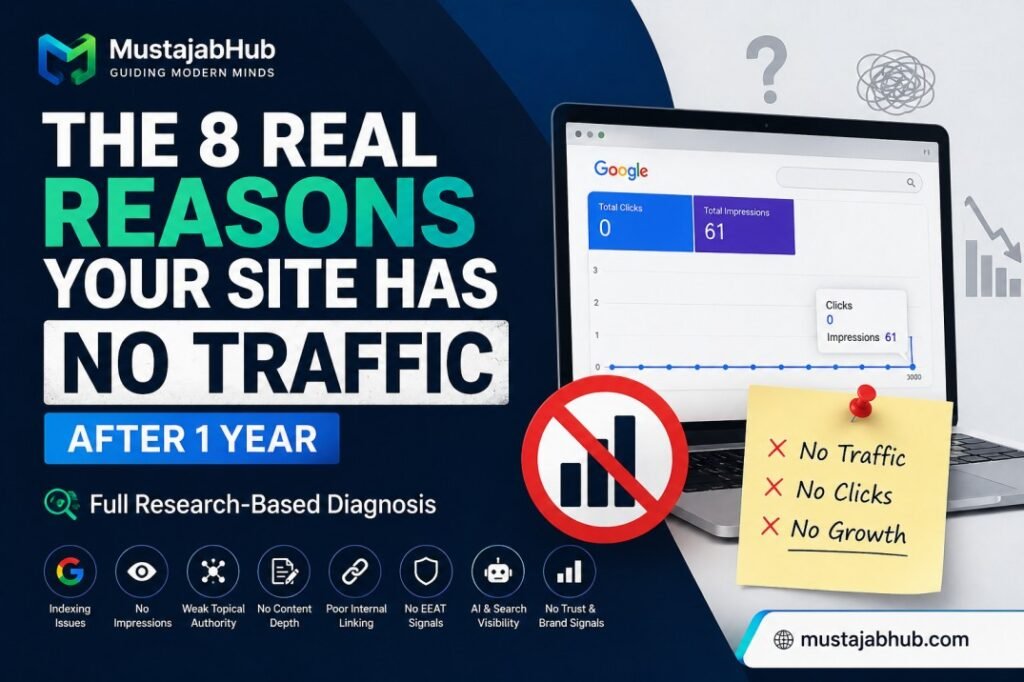

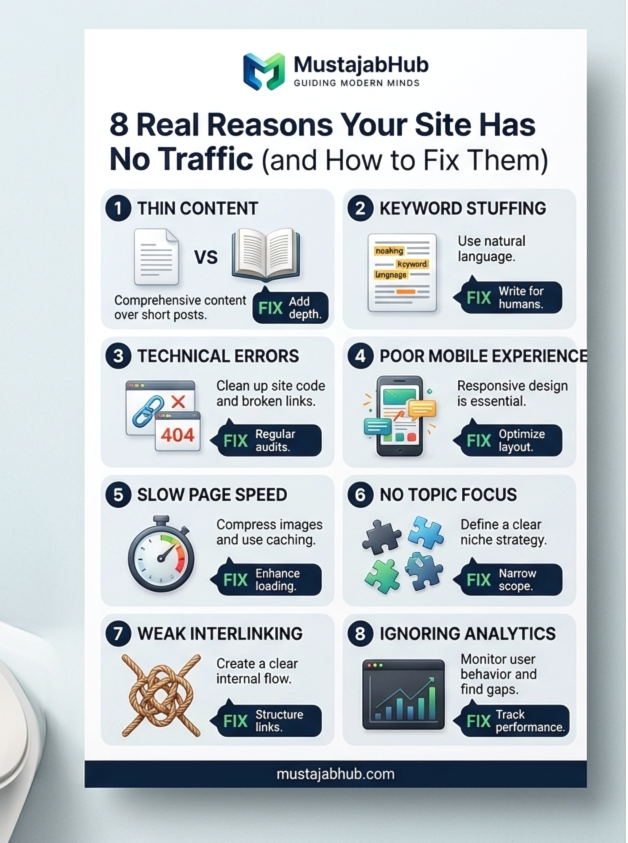
The most common reasons a website has no traffic are weak topical authority, limited supporting content, poor internal linking, low brand recognition, and insufficient evidence of expertise—not simply the age of the domain. Every reason below is backed by research data and confirmed by Google or independent SEO case studies published in 2025–2026. Over 68.01% of Google searches end in a zero-click because Google answers queries directly via AI overviews. (The real case study of Mustajabhub is discussed in this article; for real experiences shared, you can compare your website replace with mustajabhub.)
Before diagnosing your SEO & Google Search Console, you need to know this first, because it changes how you read your data.
Google confirmed a logging error caused inflated impression counts in GSC starting May 13, 2025, & the fix that rolled out on April 27, 2026, simply brought the numbers back down to where they should have been all along. Google also confirmed that clicks and other metrics were not affected by this bug. That matters, because it means a drop in impressions right now may reflect a reporting fix, not a real loss in visibility. Many site owners may see impression drops and think rankings have fallen, when the more likely explanation is that Google is correcting faulty data.
If your website has zero clicks and only 61 impressions in 7 days and you are confused about why Google not ranking my website, and this is a real, honest number—not a bug or a drop. It’s possible 80% of your site genuinely has very low visibility right now, and the reasons are listed below. The little bug didn’t hurt you — you just didn’t have enough impressions to show in the first place. Let’s fix that.
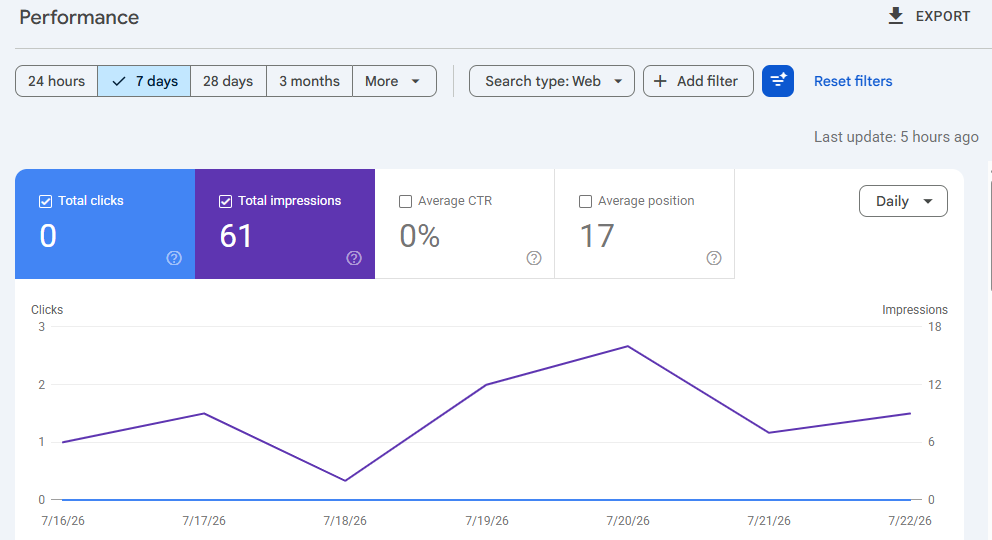
Table of Contents
❌ REASON 1 — You Are in the Google Sandbox (Still)
Many SEO experts believe search engines place new websites into a waiting period, often called the “Google Sandbox.” Google has never officially confirmed this, but new websites commonly experience low visibility while search engines evaluate trust & quality. A real 2025 DASH-SEO case study showed a dermatology practice launched with excellent content and proper technical setup, including Schema.org, an XML sitemap, SSL, and a connected Google Business Profile—and still saw near-zero organic traffic for two full months. Many websites begin seeing organic growth between 6 to 12 months, depending on competition, content quality, and consistency. It is rarely an instant process. Many entrepreneurs give up during months 3 or 4, right before the trust kicks in.
Your situation: If your site is 1 year older. You should already be past the basic sandbox period, which means the reasons below are the actual problem, not just time.
❌ REASON 2 — Zero Topical Authority Because of Too Many Unrelated Niches
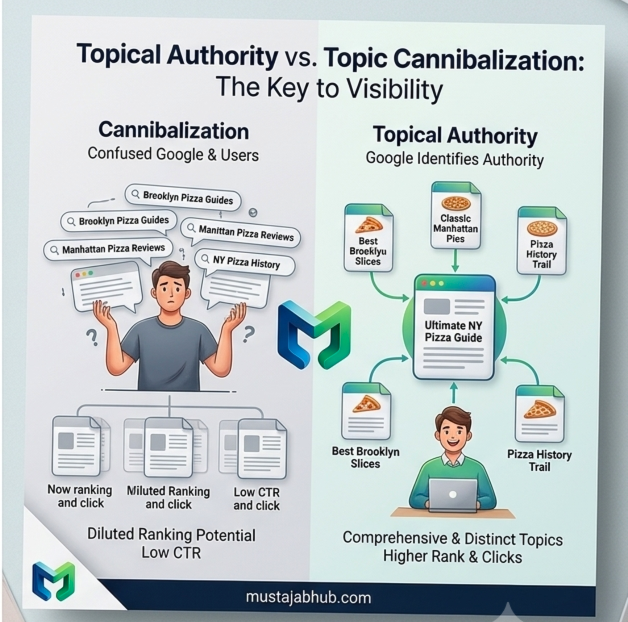
This is your biggest problem and the most fixable one. Read this carefully. Topical authority is an SEO concept where websites establish themselves as go-to experts on specific topics by covering all key aspects in depth rather than targeting individual keywords. Search engines recognize sites with topical authority as trusted sources, rewarding them with higher rankings across related searches. Straying away too far from your core topics is a serious SEO risk. ” Overclustering” is when topic clusters unrelated to your core offerings may dilute your brand if you stretch into tangential topics and subtopics.
Most paid tools said to Mustajabhub: The website has no traffic (Mustajabhub) right now; you are trying to build authority in ALL of these completely separate niches simultaneously:
| Website Development | Web dev agency | Very High |
| WordPress Speed & Optimization | WordPress technical | Medium |
| Technical SEO Fix | SEO agency | Very High |
| WhatsApp Automation | AI/automation tools | Low-Medium ✅ |
| E-Commerce Growth | Ecommerce agency | Very High |
| Amazon Services | Amazon FBA | Very High |
| SEO & Content Writing | Content agency | Very High |
| Brand & Designing | Graphic design | Very High |
| Digital Marketing | Digital marketing agency | Very High |
Those are 9 completely different niches (the real case study example of Mustajabhub for organic traffic dropped, so the website has no traffic). Google sees a new site trying to rank in 9 different industries at once, with no deep content proving expertise in any single one. Google does not know what you are. Research demonstrates that sites with strong topical authority gain traffic 57% faster than those without, while ranking faster for new content within their established expertise areas.
❌ REASON 3 — No Blog Content = No Topical Depth = No Rankings
If topical coverage is fewer than 30 articles in your niche of website, prioritize content clusters until you surpass this threshold. The more high-quality blog posts you write on any given topic, the more topical authority you will build up & the higher you will rank for Google searches related to your niche. If you write 20 or more solid, interconnected blog posts about one topic, you start earning Google’s trust as a subject-matter expert; that’s what many experts say in their blogs.
The hard truth and solution: Service pages alone do not rank. If you have 5 to 10 service pages and almost no supporting content. Google does not trust service-only sites because there is nothing to prove you actually know the topic deeply. You need a content cluster of 15–30 blog posts per niche to start seeing real rankings.
❌ REASON 4 — No Backlinks = No Domain Trust
Experts say a large number of websites receive little or no organic traffic because they lack authority, content depth, or strong backlink profiles. Searchatlas says, “If domain authority is below 20 and competitors exceed 40, allocate 60% of resources to link building until you reach parity.”
If your domain is almost certainly under DA 10 right now with no external links pointing to it. Every competitor for every one of your 6 to 9 services has been building links for years. You are competing with zero link equity against established agencies.
❌ REASON 5 — E-E-A-T Signals Are Missing
Google’s March 2026 Core Update enforced E-E-A-T (Experience, Expertise, Authoritativeness, Trustworthiness) signals at an unprecedented scale. The March 2025 core update specifically targeted AI-generated content that lacks genuine expertise signals, thin “SEO content” built around keyword density rather than user value, and pages with poor E-E-A-T signals. The fix requires adding genuine expertise markers to every page: real author bios with credentials, original case studies with specific data, and content depth that demonstrates hands-on experience. Sites that recovered fastest added first-person experience, specific data points from proprietary research & clear author attribution with verifiable expertise.
For MustajabHub: Google checks—who runs this site? Are they real? Where are their credentials? Where are their verified reviews? Where are their case studies with real data? If this information is missing or weak, Google ranks you lower until you prove your index coverage and topic clusters.
❌ REASON 6 — Brand Search Volume Is Zero
Google is now using brand search volume as a proxy for trust and authority. If real users are searching for your brand name (e.g., Mustajabhub services), your domain, or your authors by name, Google interprets this as a signal of real-world relevance. For a new sites with zero brand searches face a longer sandbox period.
If nobody is searching for “MustajabHub” yet. Google sees this as a signal that you are not a real, trusted brand yet. This compounds every other problem.
❌ REASON 7 — Thin Service Pages With No Supporting Content
Google’s Helpful Content System updates, combined with the major core updates, most significantly affected sites publishing thin content at scale, content without clear E-E-A-T signals in the present time. The key 2026 core updates specifically targeted AI-generated content farms, thin affiliate content with no original analysis, and parasite SEO pages.
For real, in the case study of Mustajabhub, service pages—even well-designed ones—are essentially thin in Google’s eyes, and even after 1 year of domain age, the website has no traffic because they are promotional, but some content is informational & some is not indexed. Google ranks pages that help users understand things, not just pages that sell services.
❌ REASON 8 — No Internal Linking Structure = Google Crawls Isolated Pages
Internal linking between topically related content is now a stronger signal than standalone page optimization methods, like before, on many sites. A clean site architecture ensures that your core service pages and supporting blog posts reinforce each other, making it effortless for Google to crawl and index your value.
You have service pages that are not connected by a web of related blog content pointing to them. They sit in isolation. Google crawls them, finds no depth, and moves on.
Solution: What if you have different niches?
Here is a direct answer to your question: Are your different niches hurting you?
Yes. 100% yes. Having 5 or 9 unrelated services is the core reason Google cannot classify your website. Here is what Google actually sees:
For a real case study of MustajabHub, see the example below:
MustajabHub.com = ?
  → Web development agency? Maybe.
  → SEO agency? Maybe.
  → Amazon seller service? Maybe.
  → WhatsApp automation tool? Maybe.
  → Graphic design studio? Maybe.
Google does not rank “maybe” sites. When Google sees that your website thoroughly covers a topic through interconnected, high-quality content, it is more likely to rank your pages above competitors who only scratch the surface.
You might have a question. I mentioned who I am on the homepage of the website and what is about me on the About Us page. Then why is Google still confused to recognize your site? The direct answer is all those 8 points on top. Try to cover them all and give time for topical authority in the time of the AI era. Most pages receive little or no organic traffic because they never build enough topical authority or backlinks.
Google does not rank websites. Google ranks documents. What Google actually wants:
- relevance
- authority
- trust
- user satisfaction
ChatGPT, Gemini, Perplexity, and Copilot do not reward keyword stuffing. What does AI search want? They reward for
- original research
- experience
- entities
- structured answers
- trustworthy sources
Here is the decision tree for ranking and authority building for your website:
No Traffic?
↓
Indexed?
↓
Yes
↓
Impressions?
↓
No
↓
Entity problem
↓
Topical Authority
↓
Content Gap
↓
Internal Links
↓
Authority
Checklist for your website traffic ranking:
- ✔ Check indexing
- ✔ Check impressions
- ✔ Check sitemap
- ✔ Check entities
- ✔ Build topical map
- ✔ Create clusters
- ✔ Add schema
- ✔ Improve internal links
- ✔ Publish consistently
WHICH SINGLE NICHE SHOULD YOU FOCUS ON FIRST?
Here is the ranked recommendation based on competition level, uniqueness of angle, and what your content with different categories, i.e., (website development, technical SEO fixes, WhatsApp automation, e-commerce growth, Amazon services, SEO & content writing, brand & design, and digital marketing) already supports, like Mustajabhub:
🥇 WINNER: WordPress Speed & Optimization
Note: This winning category answer is for the Mustajabhub case study because these 9 different niches are real case studies of Mustajabhub.
Why this niche is your best first bet:
| Factor | Detail |
|---|---|
| Competition Level | Medium — not dominated by giant agencies |
| Search Intent | Very high commercial intent — people want to hire someone |
| Your advantage | You have the service page already live |
| Content gap | Very few small agencies publish deep guides here |
| Connects to | Technical SEO Fix, Web Development, E-Commerce Growth |
| Blog category fit | Directly maps to digital-growth-guides/website-building/ |
| Pakistan + UAE angle (Your Region) | Almost no local agencies rank for this in Urdu or hindi-speaking markets |
After finalizing your winning category, you need a content cluster you can build in 90 days. (15 articles minimum) With quality, real research-based content that solves problems of real users, which people usually search for on Google and on AI. AI Overviews increasingly appear for informational searches.
Every one of these articles internally links to your service page, like Mustajabhub has a service page:( https://mustajabhub.com/wordpress-speed-optimization/ ). That is how topical authority works—the blog posts carry the service page up.
⚡ Quick Diagnosis: Why a 1-Year-Old Website Gets Zero Traffic
Google processes billions of searches every day. According to search data, 90.6% of web pages receive zero search traffic due to five primary structural issues:
- Topical Dilution: Publishing un-siloed and semantic SEO content across too many unrelated niches.
- Zero-Click AI Search: Over 68% of search queries are answered on-screen by AI Overviews without sending clicks.
- Indexation Bottlenecks: Pages marked as “Discovered – Currently Not Indexed” in Google Search Console. Internal linking is missing.
- Lack of Information Gain: Rewriting existing top 10 SERP results without unique case study data and entity SEO.
- Weak Internal Linking: Failing to route link equity to core service pillar pages.
❌ AVOID FIRST: If you have these, then avoid because niches are too competitive right now.
| Niche | Why to Skip for Now |
|---|---|
| Digital Marketing | Dominated by massive agencies with 10+ years of content |
| Amazon Services | Very competitive, Amazon-specific audience, doesn’t connect your other services |
| SEO & Content Writing | Too broad, flooded with content farms |
| E-Commerce Growth | High competition, needs huge topical depth to rank |
| Graphic Design | Visual portfolio-driven, very hard to rank via blog content |
📊 WHAT SUCCESS LOOKS LIKE — RESEARCH-BACKED TIMELINE
One B2C AI SEO case study client went from a single-page website to 1,102 keyword rankings in 17 months through systematic topical authority building. A niche site focused exclusively on sustainable home building launched with DA 12. Within 14 months, they ranked on page one for multiple high-value keywords against competitors with DA 50+. Their strategy was exhaustive topical coverage of content authority—they published 150+ deeply researched articles covering every aspect, organized into tight content silos with strategic internal linking. The reality is that AI overviews now appear on over 82% of technical, B2B, and informational queries.
| Timeline | Realistic Expectations for Example Site: MustajabHub |
|---|---|
| Month 1–2 | 200–500 impressions per week, 0–5 clicks |
| Month 3–4 | 500–2,000 impressions per week, 10–50 clicks |
| Month 6 | 2,000–8,000 impressions per week, 100–300 clicks |
| Month 9–12 | The first service page leads from organic traffic |
The Real questions people ask about fix website no traffic
Why is my website indexed but still getting no traffic?
A website being indexed simply means Google knows the page exists. It does not mean the page deserves visibility. Google still evaluates topical authority, search intent, content quality, internal linking, originality, and how well your page satisfies users compared with competing pages. In the MustajabHub case study, the pages were indexed correctly, but impressions remained low because the site had not yet developed strong topical authority in a single subject area. Building a connected content ecosystem proved more important than simply getting indexed.
Can a one-year-old website still be in Google’s Sandbox?
Google has never confirmed the existence of a “Sandbox” algorithm. However, many new websites experience a period where rankings fluctuate while Google gathers enough signals to understand their quality, expertise, & topical focus. Rather than assuming a penalty exists, focus on publishing high-quality content consistently, strengthening topical clusters, improving internal linking, & earning genuine mentions from relevant websites. These signals help Google build confidence in your site over time.
Does publishing more articles automatically increase traffic?
No. Publishing 100 unrelated articles rarely performs better than publishing 20 deeply connected articles around one topic. Modern search engines evaluate how completely a website covers a subject rather than simply counting pages. Supporting articles, comparison pages, tutorials, FAQs, case studies, & service pages should all reinforce the same topical cluster.
What is topical authority and why does Google care about it?
Topical authority is Google’s confidence that your website consistently demonstrates expertise within a specific subject. Instead of relying on one article, Google analyses how your pages connect, how comprehensively they answer related questions, & whether users can continue learning without leaving your website. Strong topical authority increases the likelihood of ranking across an entire topic rather than only individual keywords.
Why does Google rank my competitors even though my article is longer?
Length alone is not a ranking factor. Google evaluates whether the content demonstrates first-hand experience, satisfies user intent, answers follow-up questions, cites trustworthy information where appropriate, and fits naturally within a broader topical ecosystem. A shorter article that solves the user’s problem completely often performs better than a longer article filled with unnecessary information.
Should I focus on one niche before expanding my website?
For most new websites, yes. Building authority in one clearly defined niche allows Google to understand what your website specialises in. Once you become recognised for one topic and develop supporting content around it, expanding into closely related topics becomes much easier than trying to cover multiple unrelated industries from the beginning.
Can AI-generated content rank in Google?
AI-assisted writing can rank if it demonstrates originality, accuracy, first-hand experience, and genuine value. Google evaluates the usefulness of the final content rather than how it was created. Articles that simply repeat information already available elsewhere rarely perform well, regardless of whether they were written by AI or a human. Google’s people-first guidance focuses on usefulness and originality rather than the writing tool itself.
Why do I have impressions but no clicks?
Impressions indicate that Google is showing your page in search results. A lack of clicks usually points to issues such as weak titles, unappealing meta descriptions, poor keyword targeting, low search intent alignment, or the presence of SERP features like AI Overviews that satisfy the query before users click. Improving click-through rate requires understanding what searchers actually expect when they see your page.
How long does it realistically take to build topical authority?
There is no fixed timeline because it depends on competition, content quality, internal linking, brand recognition, and consistency. Many websites begin seeing stronger visibility after developing dozens of interconnected, high-quality pages around one topic rather than publishing isolated articles across unrelated subjects.
Can internal linking really improve rankings?
Yes. Internal links help search engines understand relationships between pages, distribute authority throughout your website, & guide visitors towards more detailed information. A strong internal linking structure also reinforces topical clusters by connecting pillar pages with supporting content.
Why do AI search engines cite some websites but ignore others?
AI systems increasingly favor sources that demonstrate topical expertise, clear structure, factual accuracy & original information. Well-organized content with direct answers, first-hand examples, and strong entity relationships is more likely to be referenced than generic articles that repeat existing information. Community discussions from SEO practitioners also point to deep topical coverage and brand trust as recurring factors in AI visibility.
What is the biggest mistake new websites make when trying to grow organic traffic?
The biggest mistake is trying to become an authority on everything at once. Publishing about SEO, web development, AI, Amazon, design, marketing, freelancing, and dozens of unrelated topics makes it difficult for search engines to understand what your website truly specialises in. Building authority around one focused niche first usually creates a stronger foundation for long-term growth before expanding into related areas.
THE ONE-LINE ANSWER: Why my website has no traffic?
Stop trying to rank in 5 or 9 niches at once. Pick the right category first. Publish 15-20 deep blog posts in 90 days, all pointing to your service page. Google will recognize you as an expert in those two things—and everything else will start to lift.
Once you have topical authority, new content with Google ranking factors, AI search optimisation, and AI Overviews, i.e., GEO and AEO factors, then your publish ranks faster because Google already trusts your domain on the topic. You show up for queries you never specifically targeted because your coverage signals broader expertise. Your pages hold ranking positions longer because they are part of a structured, interconnected content library rather than isolated posts.
Professional Author Profile
Writer Rana Umar
Senior Content Strategist & Search Analyst
Rana Umar is a digital content writer and online education guide with over 5 years of experience helping beginners navigate the world of digital skills, online earning & e-learning. He writes in a simple, direct style because he believes good knowledge should be easy for everyone to understand—not just experts. At MustajabHub, Rana covers practical guides on digital growth, online learning, & building real skills that lead to real results. Rana Umar, possessing over 4+ years of professional experience in technical SEO, content optimization, & best search analytics, Rana specializes in aligning editorial strategies with search engine intent. By focusing on data-driven research & practical problem-solving, the writer translates complex technical developments into clear, actionable guides that help businesses & also self-directed learners build topical authority_ Plus, improve organic search visibility & drive sustainable growth.
Read More about: litespeed-cache-vs-wp-rocket | Crawled-currently-not-indexed-fix