

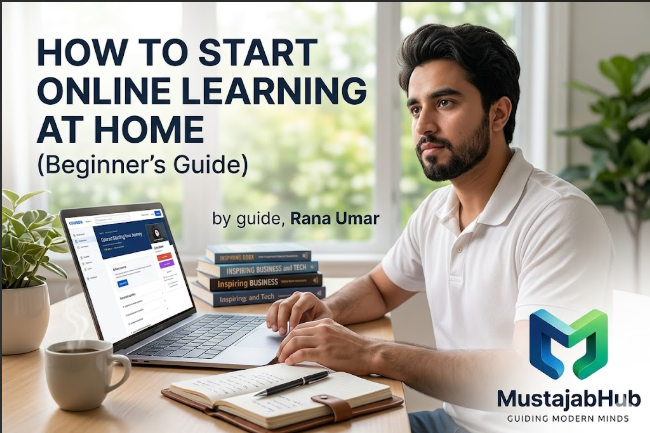
How to start online learning at home is not about being “smart” or having perfect focus. It’s about picking one clear goal, choosing one good course, and building a simple routine you can repeat even on busy days. If you want to start online classes at home but feel lost about where to begin. So, let me tell ou this first, you do not need a degree, a special computer, or lots of money to begin. Millions of people around the world are learning new skills from their living rooms, bedrooms, and kitchen tables right now. And you can too if you are consistent.
If you’re a beginnerand finding the most profitable skills to learn at home , this guide will help you avoid the biggest mistakes people make online:
- buying random courses and quitting
- studying without a plan
- watching videos but never practicing
- switching platforms every week
By the end, you’ll have a clear learning path, a weekly schedule, and a 30‑day plan you can follow.
Quick Answer: How do I get started with online learning?
Here’s the beginner-friendly start (no confusion):
- Pick one goal (job skill, school subject, freelancing skill, or personal growth)
- Choose one platform and one beginner course
- Study 30–45 minutes a day, 5 days a week
- Use practice (quizzes, notes, small projects) — not only watching
- Review weekly and adjust
That’s it. Everything else is details.
Table of Contents
How to Start Online Classes at Home: What You Need to Know First
Before you open a browser and search for courses, pause for two minutes.
Ask yourself one question: What do I actually want to learn — and why?
This sounds simple, but most beginners skip this step. They pick a random course, watch a few videos, lose interest in week two, and quit. Then they think online learning “does not work for them.”
The truth is, the course was not the problem. The goal was not clear.
When you know why you are learning something, you stay motivated even when it gets hard. So write down your reason. It might be:
- You want to earn money online as a student
- You want to get a new job or switch careers
- You want to learn a skill like design, coding, or writing
- You just want to grow personally and learn something new
Any reason is a good reason. Just know yours before you start.
1) Why online learning matters in 2026–2027 (no fear, just facts)
Online learning is growing because the world of work is changing fast. (AI + skill Guide)
The World Economic Forum says that, on average, workers can expect 39% of their current core skills to change by 2030.
Here’s a short line from the same report that explains the pressure clearly:
“If the world’s workforce was made up of 100 people, 59 would need training by 2030.”
That doesn’t mean you must study 6 hours a day. It means learning has become normal, like using a smartphone.
Also, platforms have exploded in size. Coursera reported 191 million total learners and 22 million new learners in 2025 (data as of Sept 30, 2025).
So if you feel “late,” you’re not late. You’re entering at the right time to earn money online as a student —when online learning is finally common and easier than before.
2) Choose your goal (this decides everything)
Most beginners fail because they start like this:
“I want to learn online… but I don’t know how to start online learning at home or what they really want and might be confused.”
So they open YouTube, watch random videos, and quit.
Instead, choose one goal from these 4:
Goal A: Learn for a job (fast path)
Skills to learn to make money best for: students, job seekers, career switchers
Pick skills like:
- Excel / Google Sheets
- customer support
- basic data skills
- digital marketing basics
- project management basics
Goal B: Learn for your studies (school/college)
Best for: exam prep, class improvement, academic etc
Pick:
- math, physics, accounting, programming basics
You need more practice and less “course shopping.”
Goal C: Learn for freelancing/business
Best for: earning skills (but this post is about learning, not income)
Pick one skill and build a mini portfolio.
Goal D: Learn for personal growth
Best for: English, communication, confidence, mental health, productivity
Rule: If you’re stuck, pick Goal A (job skill). It gives the clearest path.
If you want earning skills, read this next.
3) How to pick the right beginner course (simple scorecard)
When you search “How to Start Your Online Learning”, everything looks “best.” So use this scorecard like below.
The Beginner Course Scorecard (0–10)
Give each course points:
| Check | Points |
|---|---|
| Has a clear beginner label + no heavy prerequisites | 2 |
| Includes practice (quizzes, tasks, small projects) | 2 |
| Has a simple roadmap (weeks/modules) | 2 |
| Has subtitles/transcripts (great for learning in English) | 1 |
| Has a community (forum / group / discussion) | 1 |
| You can finish it in 2–6 weeks | 2 |
Pick courses that score 7+/10.
If it’s 4/10, it may still be a good course—but not for a beginner.
4) Best online learning platforms for beginners (comparison table)
This table is intentionally simple. I’m not adding complicated pricing because it changes often.
| Platform type | Best for | Good for beginners? | What to watch out for |
|---|---|---|---|
| MOOC platforms (university-style) | structured learning + certificates | Yes | can feel long; don’t pick advanced courses |
| Marketplace platforms | cheap variety + specific topics | Yes | quality is mixed; check reviews and practice content |
| Free learning sites | basics + confidence | Yes | may lack a clear roadmap |
| Career certificate programs | job-focused skills | Yes | requires consistent weekly study |
The beginner rule for platforms
Don’t just choose the “perfect platform.” if you are searching how to start online learning at home or anywhere. Instead, choose the platform you will actually use 4–5 days a week.
5) What are the top 3 courses to start with? (beginner-safe picks)
People ask this a lot, and the honest answer is: it depends on your goal. If you want a skill list, here are options.
But if you want 3 safe starting points that help almost everyone:
1) Excel / Google Sheets basics
Why: useful in study + jobs + business
Result: you can track work, budgets, simple reports, and data
2) Communication + writing basics
Why: helps interviews, freelancing, emails, confidence
Result: better messages, better explanations, better grades/work output
3) One tech foundation (choose 1)
Pick one:
- basic computer skills + file management
- beginner coding (if you enjoy it)
- data basics (if you like numbers)
Tip: Don’t start with “AI advanced” if you don’t have basics. Start simple and build.
6) The Beginner Weekly Schedule
Online learning fails when it has no fixed place in your week.
Here are 2 schedules. Pick one.
Option 1: Busy student schedule (30–45 min/day)
- Mon: Watch lesson + notes (30–45 min)
- Tue: Practice (quiz / exercises) (30–45 min)
- Wed: Watch next lesson + notes (30–45 min)
- Thu: Practice + tiny project (30–45 min)
- Fri: Review + summary page (30 min)
- Sat: optional catch-up (30–60 min)
- Sun: off (rest)
Option 2: Weekend schedule (if weekdays are hard)
- Sat: 2 hours (lesson + practice)
- Sun: 2 hours (lesson + practice + review)
Rule: Practice time must exist. Watching only feels productive, but your brain forgets fast.
Sample Weekly Study Plan for Beginners
| Day | Study Time | What to Do |
|---|---|---|
| Monday | 45 minutes | Watch lesson videos + take notes |
| Tuesday | 30 minutes | Review notes, do a short quiz or exercise |
| Wednesday | Off | Rest your brain — no studying |
| Thursday | 45 minutes | Continue course + practice what you learned |
| Friday | 30 minutes | Apply the skill (do a small task or project) |
| Saturday | 60 minutes | Deep work — review week, try something hands-on |
| Sunday | Off | Relax |
You do not need to study for hours every day. Consistency beats intensity every time.
7) 7 study methods that work best for online learning (simple + proven)
You asked for “7 secret methods.” I’ll give you 7 real methods that work because they match how memory works.
A big one is spacing: spreading study across sessions. A study in an actual MOOC found that spacing study across multiple sessions was linked to higher quiz performance.
Method 1: Spaced study (don’t cram)
Study 30–45 minutes today. Repeat tomorrow. Repeat next week.
Method 2: Active recall (pull from memory)
After a lesson, close the video and write:
- What do I remember?
- What steps can I repeat?
- What is still confusing?
Method 3: Tiny projects (learn by doing)
If you’re learning Excel, build a sheet. If you’re learning writing, write 300 words. If you’re learning coding, build a tiny script.
Method 4: Make 1-page notes (not 20 pages)
Your goal is a one-page “cheat sheet” you can review in 5 minutes.
Method 5: Teach it in simple words
Explain the topic like you are helping a friend.
Method 6: Remove 1 distraction (not 10)
Don’t aim for “perfect focus.” Just do this:
- phone in another room for 30 minutes
Method 7: Weekly review (the glue)
Once a week, write:
- what I learned
- what I can do now
- what I will do next week
That’s how online learning becomes real progress you will get.
8) “7 ways of learning” (quick answer without confusion)
You may hear people say: visual, auditory, reading/writing, kinesthetic, etc.
Here’s the simple truth for beginners:
- Yes, people have preferences.
- But your results come more from practice + review + consistency than from labels.
So instead of trying to “find your learning style,” do this:
- If it’s a skill: practice it
- If it’s knowledge: quiz yourself
- If it’s language: use it daily
9) Common online learning problems (and simple fixes)
Problem: “I start strong, then disappear”
Fix: Make the goal smaller.
- Not “finish the course”
- Do “30 minutes today”
Problem: “I don’t understand English well”
Fix:
- Use subtitles + transcripts
- pause and write keywords
- re-watch only the confusing parts
- keep a small vocabulary list (10 new words/week)
Problem: “Too many courses, too many tabs”
Fix: One platform, one course, 30 days. You can switch later. Not now.
Problem: “I forget what I watched”
Fix: Always end a session with:
- 5 bullet notes
- 5-minute quiz (or questions you write yourself)
Problem: “No motivation”
Fix: Motivation comes after progress. Start the session first. Motivation often arrives at minute 10.
Deal with the Most Common Problems Beginners Face
Here are real problems beginners face at home — & simple ways to fix them easily:
Problem vs Solution Table
| Common Problem | Why It Happens | Simple Fix |
|---|---|---|
| “I can’t focus at home” | Too many distractions | Use noise-cancelling headphones + set a timer |
| “I start but never finish courses” | No clear goal or deadline | Set a personal finish date for each course |
| “There are too many courses to choose from” | Analysis paralysis | Pick one 4-star or higher rated course and start |
| “I forget what I learned” | No active practice | Use the 5-step method above |
| “I get bored quickly” | Wrong topic or wrong format | Switch to shorter lessons or a different teaching style |
| “I have no time” | No schedule built | Block 30 minutes in your calendar like a meeting |
| “I feel like I’m not good enough” | Comparison to others | Everyone starts at zero — focus on your progress only |
10) The 30‑Day Online Learning Plan (how to start online learning at home)
This is the part that makes the post original and useful.
Week 1: Setup + start
- Day 1: Pick goal + pick course (scorecard)
- Day 2: Watch first lesson + 5 bullet notes
- Day 3: Practice (quiz/exercises)
- Day 4: Lesson 2 + notes
- Day 5: Practice + small task
- Day 6: Review week + 1‑page summary
- Day 7: Off
Week 2: Build the habit
- Same pattern, but add:
- one “teach it” voice note (2 minutes)
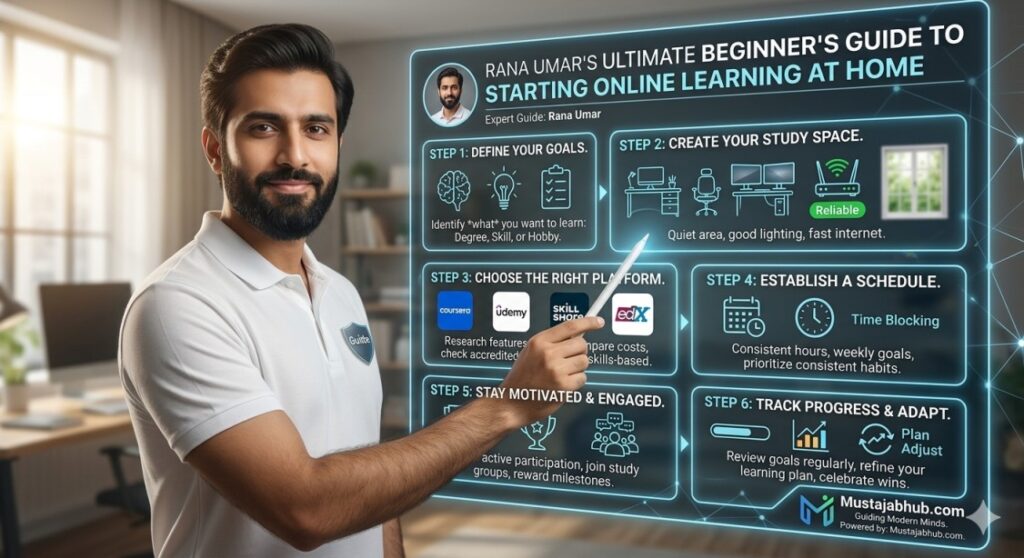
Week 3: Make it real
- Build a tiny project:
- a spreadsheet
- a 300-word article
- a small presentation
- a mini portfolio page draft
Week 4: Finish + prove it
- Finish the course (or finish 70% if it’s long)
- Create proof:
- certificate (if available)
- project file
- screenshots
- a short post: “What I learned in 30 days”
You don’t need perfection. You need proof + consistency.
Choose the Right Platform
This is where most beginners feel overwhelmed. There are dozens of online learning platforms. But you do not need to try all of them. Here is a simple comparison to help you decide:
Free Platforms (Best for Beginners Who Want to Start at Zero Cost)
| Platform | What It Offers | Best For |
|---|---|---|
| YouTube | Video tutorials on everything | Visual learners, any topic |
| Coursera | University courses (audit for free) | Career skills, certifications |
| edX | MIT and Harvard courses (free audit) | Academic learning |
| Khan Academy | Math, science, humanities | Students, school subjects |
| Google Digital Garage | Digital marketing, data, career skills | Business beginners |
| HubSpot Academy | Marketing, sales, CRM | Digital marketing students |
| Alison | Certificate courses in many fields | Skill-based learning |
Paid Platforms (Worth It When You Are Ready to Go Deeper)
| Platform | Cost | Best For |
|---|---|---|
| Udemy | $10–$20 per course (on sale often) | Practical, skill-based courses |
| Skillshare | Monthly subscription | Creative skills, design |
| LinkedIn Learning | Monthly subscription | Professional development |
| MasterClass | Annual subscription | Learning from top experts |
Beginner advice: Start with a free platform first. Prove to yourself you can finish something. Then invest in a paid course later when you have the habit built.
FAQs_How to Start Online Learning at Home
How do I start online learning at home as a beginner?
Pick one goal, choose one beginner course, study 30–45 minutes a day (5 days/week), and practice with quizzes or small projects. Keep it simple for 30 days.
What is the best platform for online learning for beginners?
The best platform is the one you can use consistently. Beginners usually do well with structured beginner courses that include practice, a clear roadmap, and subtitles.
How many hours should I study online per day?
For beginners, 30–60 minutes per day is enough if you do it 4–6 days a week. Consistency beats long study sessions.
Why do I forget what I learn online?
Most people forget because they only watch. Fix it with active recall: take short notes, quiz yourself, and practice the skill right after the lesson.
What are the top 3 courses to start with online?
A safe start for most beginners is: (1) Excel/Google Sheets basics, (2) communication or writing basics, and (3) one foundation skill like coding basics or data basics.
How can I stay consistent with online learning?
Use a weekly schedule, remove one distraction (like your phone), and keep the daily goal small (30 minutes). Review your progress every week.
How can I learn online in English if my English is weak?
Use subtitles, pause often, write keywords, build a small vocabulary list, and repeat the same lesson in short sessions instead of rushing forward.
Is online learning worth it in 2026–2027?
Yes, because skill needs are changing fast every year. Reports show a large share of workers will need training by 2030, so learning small skills now can protect your future.
Final Words
Online learning is not magic. It’s a daily routine if you really finding on internet, how to start online learning at home.
Pick one goal only at first. Pick one course. Study in small sessions. Practice more than you watch. Review weekly.
That’s how beginners become skilled.
Need help setting up a learning website or automation? Explore more step-by-step guides For Best Free Automation Tools.
Professional Author Profile
Writer Rana Umar
Senior Content Strategist & Search Analyst
Rana Umar is a digital content writer and online education guide with over five + years of experience helping beginners navigate the world of digital skills, online earning, & e-learning. He writes in a simple, direct style because he believes good knowledge should be easy for everyone to understand — not just experts. At MustajabHub, Rana covers practical guides on digital growth, online learning, & building real skills that lead to real results. Rana Umar possessing over 4+ years of professional experience in technical SEO, content optimization, & best search analytics, Rana specializes in aligning editorial strategies with search engine intent. By focusing on data-driven research & practical problem-solving, the writer translates complex technical developments into clear, actionable guides that help businesses & also self-directed learners build topical authority_ Plus, improve organic search visibility, & drive sustainable growth.