


If you own a small business website and feel like Google only ranks giant companies, you are not alone. In this guide we discover free SEO tools for beginners and advanced users to rank their websites easily on Google and get real results.
In my personal experience I saw a lot of business owners who spent months publishing blog posts, changing keywords, or buying random SEO services, only to see almost no traffic growth, especially in Asia (Bangladesh, India, and Pakistan). The problem usually is not effort but consistency, and the main problem is targeting the wrong keywords & niche and then creating content that does not fully match with search intents.
In 2026, SEO is not about stuffing keywords into articles like before anymore. Google is not generically blind, & it now understands topics, entities, user behaviour, content depth, & trust signals (EEAT) much better than before. That means small websites can still rank, but only if they become genuinely useful and focused on their customers.
After researching current top-ranking page-one SEO articles, forums & ranking patterns, one thing became very clear 100%:
Most websites are still missing practical, human-first, experienced content that answers real questions of problems from real business owners. If they do this, that is exactly where small websites can easily win in just 3-6 months.
This guide will show you a realistic SEO experience-based strategy for small business websites / new blogs, especially if your site is new or has low authority (DA/DR).
Table of Contents
Why Most Small Business Websites Fail in SEO ?
A lot of beginners think SEO means:
- Adding keywords everywhere in content
- Writing 500-word articles only
- Installing an SEO plugin and done
- Buying backlinks (helps after right seo)
- Using AI to mass-produce content (like Chatgbt content)
That approach worked few years ago. It does not work consistently anymore in 2026 -2027 . Google’s systems now evaluate:
or
- User experience
- Search intent
- Topical authority
- Website trust
- Content usefulness
- Real expertise
- Engagement signals
- Brand consistency
- Entity relationships
Many websites fail because they chase high-volume keywords that are almost impossible to rank for Google / Bing. For example:
- “SEO”
- “digital marketing”
- “website development”
- “online business”
These keywords are dominated by giant websites with huge backlink profiles.
A smarter strategy is targeting low-competition and long-tail keywords with clear intent.
Instead of:
- “SEO” (One Gaint Keyword)
Target:
- “SEO strategy for small business website”
- “how to rank local business website on Google”
- “easy SEO tips for beginners”
- “how to improve Google rankings without backlinks”
These are easier keywords to rank and usually convert better now.
What Actually Works in SEO Right Now ?
After analyzing the top ranking trends & discussions across SEO communities, several patterns in many platforms, I find out.
1. Helpful Content Wins More Than Perfect SEO
Google increasingly rewards pages that resolve problems clearly.
That means:
- Real examples
- Clear explanations
- Simple structure
- Practical advice
- Original insights
- Human experience
A short useful article often beats a long generic article.
But if you want stronger rankings in competitive niches, depth still matters and that is why comprehensive content usually performs better when written properly.
2. Search Intent Matters More Than Keyword Density
One of the biggest SEO mistakes is doing by writer communities, that it does not match what users actually want and searching. For example:
If someone searches:
“best SEO tools for beginners” “how to rank with paid tools”
They truely want:
- Recommendations
- Pricing
- Ease of use
- Pros and cons
They do not want:
- A history lesson about SEO when they works and wht they failed.
Google measures how users interact with content. If visitors leave quickly because your page does not answer their question, rankings usually drop over time.
3. Topical Authority Is More Important Than Random Blogging
Many websites publish unrelated articles hoping one goes viral.
That strategy weakens topical relevance.
Instead, Google prefers websites deeply focused on one subject.
For example, a website about:
- SEO
- website optimization
- Google rankings
- blogging
- content marketing
has a better chance of ranking SEO-related articles consistently. This is called topical authority.
The Best Easy-to-Rank Keyword Strategy for New Websites
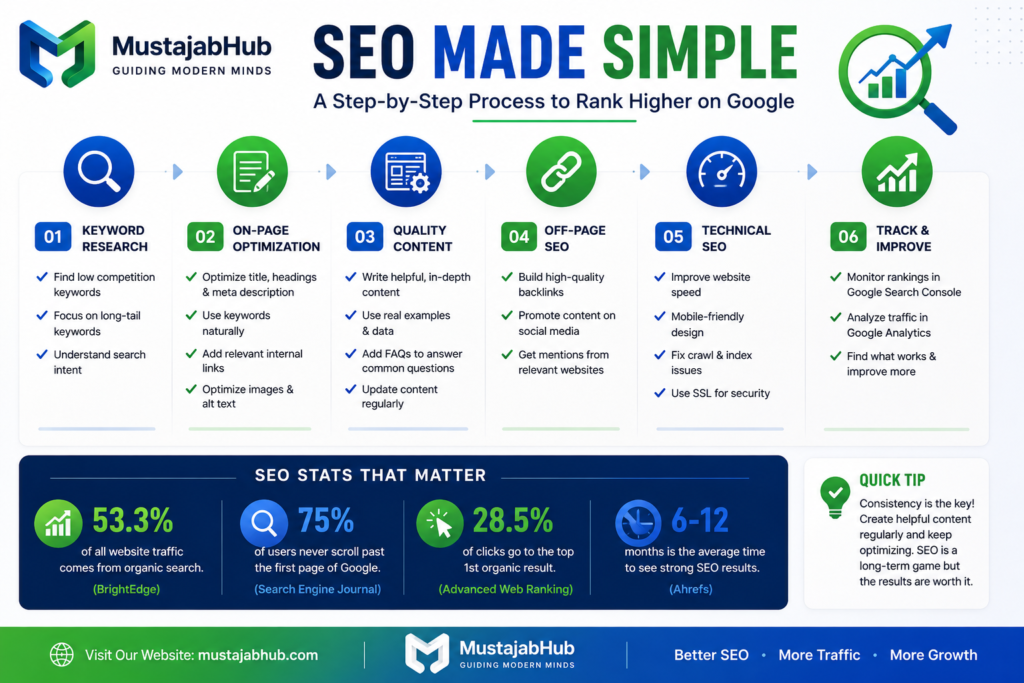
One major issue with beginner blogs is choosing impossible keywords. The better approach is this:
You must focus on:
- Long-tail keywords
- Low competition phrases
- Question-based searches
- Problem-solving content
- Local intent keywords
- Service + city keywords
Examples:
- how to rank a new website on Google
- SEO tips for small business owners
- best free SEO tools for beginners
- how to get traffic without ads
- local SEO checklist for beginners
- why my website is not ranking
These keywords often have:
- lower competition
- clearer intent
- faster ranking potential
They also attract visitors who actually need help.
=> If you need need long tailed keywords & Free audits for your business websites or blog, Mustajabhub helps in adsense & ranking on Top Page.
How Google Understands Semantic SEO in 2026
SEO is no longer based on repeating the same keyword 20 times after and after.
Google now understands entities and topic relationships because they have now lots of data available.
For example, if your article is about small business SEO, Google expects related entities naturally inside the content, such as:
- Google Search Console
- Keywords
- Backlinks
- Technical SEO
- Local SEO
- Search intent
- Website speed
- Internal linking
- Content optimization
- User experience
- Schema markup
- Mobile optimization
- Google Business Profile
- Organic traffic
This helps Google to understand the topic deeply and than Google relates with the user intents. That is why modern SEO articles feel more natural and comprehensive in present time.
Real SEO Problems Small Businesses Face
Here are common issues many small business owners experience:
“I publish blogs but get no traffic.”
Usually caused by:
- Targeting difficult keywords
- Weak content structure
- No internal linking
- Poor search intent match
- Thin content
“My competitor ranks higher with worse content.”
Often because:
- their website has stronger authority
- better internal links
- more trust signals
- better user engagement
- older domain history
“Does AI content hurt rankings?”
AI itself is not the issue.
Low-quality content is.
- If your content feels robotic, repetitive, more generic, or inaccurate, then rankings suffer.
- Human experienced based editing, the real examples, unique insights, & proper structure still matter heavily.
- Most small business websites and blogs are builted like online brochures instead of search-focused assets.
So, Google does not rank websites simply because they exists on internet. It ranks pages that solve problems for users better than competitors. That is why many small businesses feel invisible online still yet even when their services are genuinely good.
- A local plumber may provide better service than larger companies.
- A startup agency may care more about clients than expensive competitors.
- A freelancer may work harder than big firms.
But without SEO structure, search engines cannot fully understand that value. And this is where smart SEO strategy changes everything.
The SEO Structure That Works Best for Blog Posts
A strong SEO blog structure usually includes:
1. Clear H1 Title
Use the primary keyword naturally.
Example:
“Easy SEO Strategy for Small Business Websites”
2. Strong Introduction
Explain:
- the problem
- why it matters
- what readers will learn
3. Proper Heading Structure
Use:
- H2 for main sections
- H3 for subtopics
This improves readability and SEO clarity.
4. Natural Keyword Placement
Add keywords naturally in:
- Title
- First paragraph
- Headings
- Image alt text
- Meta description
Avoid keyword stuffing.
5. FAQ Section
Question-based content ranks well because it matches voice searches and AI search behavior.
Real Questions Business Owners Ask About SEO
How long does SEO take for a new website?
Usually:
- 3 to 6 months for early movement
- 6 to 12 months for stronger growth
It depends on:
- competition
- content quality
- consistency
- backlinks
- niche authority
Is blogging still worth it in 2026?
Yes, but only if:
- the content is useful
- the topic has search demand
- the article matches intent
- the site builds topical authority
Random blogging without strategy rarely works now.
Should small businesses focus on local SEO?
Absolutely.
Local SEO is often the easiest traffic source for small businesses.
Optimizing:
- Google Business Profile
- local keywords
- reviews
- citations
- service pages
can bring faster results than broad national SEO.
How many blog posts should a new website publish?
Quality matters more than quantity.
A focused website with:
- 20 strong articles
can outperform: - 200 weak articles.
Consistency still matters though.
A practical target:
- 1 to 2 high-quality articles weekly.
SEO Statistics Small Businesses Should Know in 2026
| SEO Insight | Real Impact on Businesses |
|---|---|
| Over 90% of online experiences start with search engines | Organic visibility still drives discovery |
| Most users never visit page 2 of Google | Ranking position matters heavily |
| Mobile searches dominate local intent | Mobile speed and UX are critical |
| Websites with blogs generate significantly more indexed pages | More opportunities to rank |
| Internal linking improves crawlability and user engagement | Helps rankings and session time |
| High-quality content earns backlinks naturally over time | Authority grows gradually |
| Local SEO strongly influences buying decisions | Especially for service businesses |
The Biggest SEO Mistakes Beginners Make
Publishing AI Content Without Editing
Google increasingly identifies low-value mass-generated content.
Readers also recognize robotic writing quickly.
Always:
- Rewrite
- Add examples
- Improve flow
- include real insights
Ignoring Internal Linking
Internal links help:
- Distribute authority
- Improve crawling
- Increase engagement
- Build topic relationships
Every article should naturally link to related pages.
Writing for Search Engines Instead of Humans
Good SEO content should feel natural first.
If your article sounds robotic or over-optimized, readers leave quickly.
That hurts rankings.
Ignoring Technical SEO
Even great content struggles if:
- pages load slowly
- mobile experience is poor
- indexing problems exist
- broken links appear
Basic technical SEO still matters heavily.
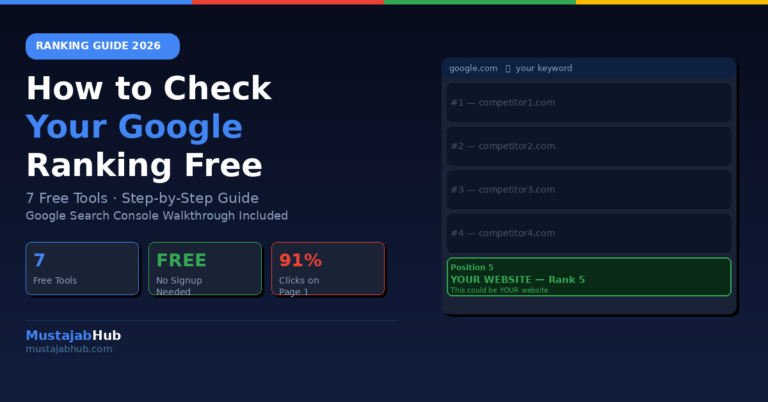
The Best Free SEO Tools for Beginners
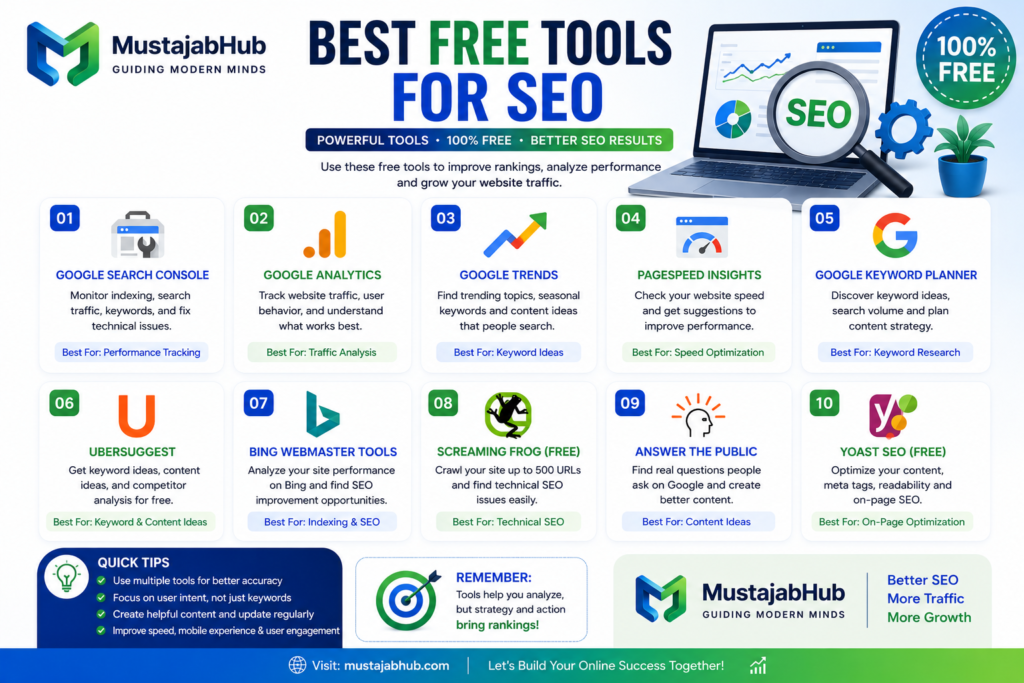
Google Search Console
Essential for:
- Indexing
- Performance tracking
- Keyword discovery
- Click-through analysis
Google Analytics
Helps understand:
- Traffic
- User behavior
- Engagement
Google Trends
Useful for:
- Trending topics
- Seasonal keywords
- Search behavior
Ahrefs Free Tools
Helpful for:
- Keyword ideas
- Backlink checking
Ubersuggest
Good for beginners learning keyword research.
What Small Websites Can Still Beat Big Brands At
Large websites often publish broad, generic content.
Small websites can win by creating:
- Niche-focused content
- Local expertise
- Experience-based articles
- Practical guides
- Highly targeted long-tail content
For example:
A local business article titled:
“Best SEO Strategy for Real Estate Agents in Houston”
may outrank giant websites because it better matches intent.
Specificity matters.
The Future of SEO Is Moving Toward Trust
Search engines increasingly evaluate:
- Author credibility
- Business legitimacy
- Expertise
- Real-world signals
- Consistency across platforms
That means:
- Real author profiles help
- Genuine reviews help
- Transparent business information helps
- Original insights help
SEO is becoming more connected to brand trust.
A Simple SEO Plan for Beginners
If you are tired or overwhelmed, start from here:
Step 1: Choose one demanding micro niche topic
Step 2 : Find low-competition + long-tail keywords
Step 3 : Write one deeply useful article weekly
Step 4: Improve the internal linking
Step 5: Optimize on technical basics: Speed + Mobile usability + indexing
Step 6: Update the old content regularly
Refreshing existing pages often produces faster ranking improvements than publishing new articles constantly.
Step-by-Step SEO Strategy That Still Works in 2026
Step 1: Start With Low Competition Search Intent
Most beginners make a dangerous mistake:
they target massive keywords too early.
For example:
- “SEO”
- “Digital marketing”
- “Website design”
These are extremely competitive.
Instead, smarter businesses target intent-focused searches like:
- “easy seo strategy for small business websites”
- “best seo tips for local businesses”
- “how to rank wordpress website in google”
- “seo checklist for beginner business owners”
Long-tail keywords bring:
- Easier rankings
- Higher conversion rates
- More targeted traffic
Step 2: Build Topical Authority Instead of Random Blogs
Google increasingly rewards websites that deeply cover a subject.
Instead of writing random articles, build topic clusters.
Example for an SEO website:
- Technical SEO guide
- On-page SEO checklist
- Keyword research tutorial
- Internal linking strategy
- Local SEO guide
- SEO mistakes to avoid
- Free SEO tools guide
This creates semantic relevance across hundreds of related search terms.
Step 3: Fix Technical SEO Before Publishing More Content
Many websites lose rankings because of technical problems:
- Slow loading speed
- Poor mobile experience
- Broken links
- Thin pages
- Indexing issues
- Bad internal linking
Important tools:
Technical SEO is not glamorous, but it creates the foundation for rankings on top in searches.
Step 4: Write Like an experienced Human Expert, Not a Search Engine
One major reason content fails today is emotional emptiness.
Many articles sound robotic:
- Generic intros
- Repetitive advice
- Zero experience
- No personality
- No empathy
People stay longer on content that feels real.
Good SEO writing now includes:
- Relatable examples
- Frustrations readers face
- Practical solutions
- Natural language
- Simple explanations
- Original opinions
Search engines increasingly measure user satisfaction signals.
Step 5: Improve Internal Linking Strategically
Internal linking is heavily underestimated still in 2026.
Every new article should connect naturally to related pages.
Example:
A blog about keyword research should link to:
- Content optimization guide
- Technical SEO article
- Free SEO tools page
- On-page SEO checklist
This helps:
- Distribute authority
- Improve crawl depth
- Increase session duration
- Strengthen semantic relationships
Step 6: Optimize for your Local SEO Signals
For small businesses, local SEO can drive faster results than international SEO.
Key areas:
- Google Business Profile optimization
- Local keywords
- Reviews
- Location pages
- Local citations
- Map visibility
Important entities:
Local trust signals strongly influence conversions.
Why Consistency Beats SEO Tricks?
A lot of website owners secretly keep searching for shortcuts.
One perfect tool.
One AI trick.
One viral keyword.
One backlink package.
But sustainable SEO growth usually comes from small consistent improvements.
The websites that quietly grow over time are often the ones that:
- Publish consistently
- Improve user experience
- Answer real questions
- Update old content
- Build trust slowly
SEO in 2026 is less about to manipulating algorithms but more about creating genuinely useful online. That intent shift is actually good news for small businesses & for bloggers. Because helpful businesses finally have a real chance to compete.
Frequently Asked Questions About SEO for Small Business Websites
How long does SEO take for a small business website to rank?
After right SEO many small business websites start seeing early improvements within 3 to 6 months if the website is technically healthy and content is published consistently. Competitive industries may take longer time. SEO is a long-term growth strategy, not a quick traffic hack.
Is SEO still worth it in 2026 or not?
Yes. SEO is still one of the highest ROI marketing channels because people continue searching things on Google Search every day for services, products, reviews, comparisons, & local businesses. AI search experiences also increasing the importance of trustworthy and experience-based content instead of reducing it.
What is the easiest SEO strategy for beginners?
The easiest strategy is:
* Target low-competition keywords
* Fix technical SEO basics
* Publish genuinely helpful content
* Improve internal linking
* Optimize Google Business Profile
* Build topical authority slowly
Many small businesses fail because they chase competitive keywords too early.
Do small businesses need expensive SEO tools?
Do small businesses need expensive SEO tools?
* Google Search Console
* Google Analytics
* Google Trends
* PageSpeed Insights
* Ahrefs Free Tools
Most beginners need strategy more than software.
Why are my website impressions increasing but clicks are not?
This usually happens because:
* Your title tags are weak
* Meta descriptions are not attractive
* You rank on page 2 or lower
* Search intent does not match the content
* Competitors have stronger branding
Improving CTR often increases traffic without needing more rankings.
Does AI-generated content hurt SEO?
Yes ! Low-quality AI spammy content usally hurt trust & engagement. But well-edited, real experience-based, human-focused AI-assisted content can perform well when it provides original value & solves real problems.
What type of content ranks fastest for small businesses and companies?
Usually:
* Local guides
* Problem-solving articles
* Comparison posts
* Beginner tutorials
* Service-related FAQs
* Industry mistakes and solutions
* Real case studies
Google increasingly rewards practical content that helps users make decisions quickly.
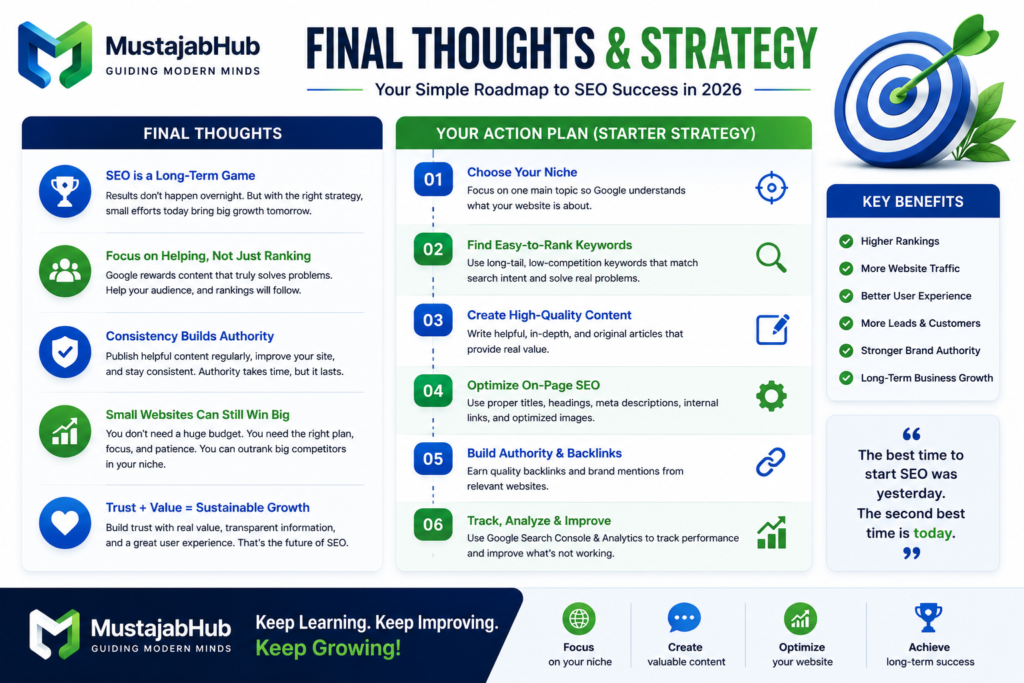
Final Thoughts
SEO is still one of the best long-term traffic strategies for small businesses.
But the old shortcut methods are fading fast.
In 2026, the websites growing consistently are usually the ones that:
- Answer real questions
- Solve real problems
- Focus on topical authority
- Create human-first content
- Build trust over time
The good news is that small websites still have huge opportunities.
You do not need thousands of backlinks or a giant team to grow.
You need:
- The right keyword strategy
- Genuinely useful content
- Consistency
- Patience
Most websites quit too early.
The ones that continue improving content, understanding user intent, and building authority steadily are usually the ones that eventually dominate their niche.
About the Author
Written by Rana Umar — Content Writer and SEO Specialist at MustajabHub.
Rana Umar works on SEO, websites, technical search optimization and digital growth for businesses.
Experience: 5+ years of experience now
Based in: Pakistan.
Areas of expertise: Technical SEO, Google Search Console, WordPress, local SEO and website performance.
Read More Related Topics Here:
Elementor vs Gutenberg Pakistan | WordPress Website Development Cost in Gujranwala | WordPress vs Custom Website Pakistan | Technical-seo-audit-checklist | Why-is-my-wordpress-website-slow | how to get Google AdSense approved in Pakistan | ssl-certificate-pakistan-website | fix-lcp-wordpress-pakistan | cloudflare-setup-wordpress-pakistan | google-pagespeed-score-wordpress-pakistan | Best Free WordPress Theme for Local Agency | crawled-currently-not-indexed-fix-pakistan | Robots.txt AI Crawlers WordPress



I read this article and I found that its for beginners and for those who are struck in loop hole and dont get traffic enough. The free tools mustajabhub you mentions is really great because I only use 2 of them but from now I can use other free seo tools also to rank my customers sites. Thank you for this info.
wish you all the best