
You type your business name into Google. Nothing. You type your main service. Competitors show up. Your website is on page 4. Nobody ever goes to page 4.
That feeling — knowing you built something good but nobody can find it — is one of the most frustrating experiences in running a business online. And the truth is, it is fixable. Google’s ranking system is not random. It is not mysterious. It follows rules. Learn the rules, follow them consistently, and your website moves up.
This guide explains exactly how Google ranking works in 2026, what factors matter most right now, and the step-by-step process to get your website to the first page — whether you are in Pakistan, the US, or anywhere else.
Table of Contents
How Does Google Decide Who Ranks on the First Page?
Think of Google as the world’s most organized librarian. Every day, it reads billions of web pages and sorts them into a giant index. When someone searches “best web developer in Pakistan,” Google takes 0.5 seconds to look through that index and pull the most relevant, trustworthy, and helpful pages — in order.
Google uses automated ranking systems that look at many factors and signals about hundreds of billions of web pages to present the most relevant, useful results in a fraction of a second. These systems work on the page level using a variety of signals to understand how to rank individual pages. Raddevon
Google is looking for three things from every page it considers ranking:
Relevance — Does this page actually answer what the person searched for? A page about “WordPress speed” should not rank when someone searches “web developer Rawalpindi.” Intent must match.
Authority — Is this website trustworthy? Are other respected websites linking to it? Has it been publishing quality content consistently?
Experience — Is the website fast? Does it work on mobile? Do visitors stay and read, or do they immediately click back?
Get all three right, and your website moves to page one. Miss any one of them, and your site stays buried.
What Are the Most Important Google Ranking Factors in 2026?
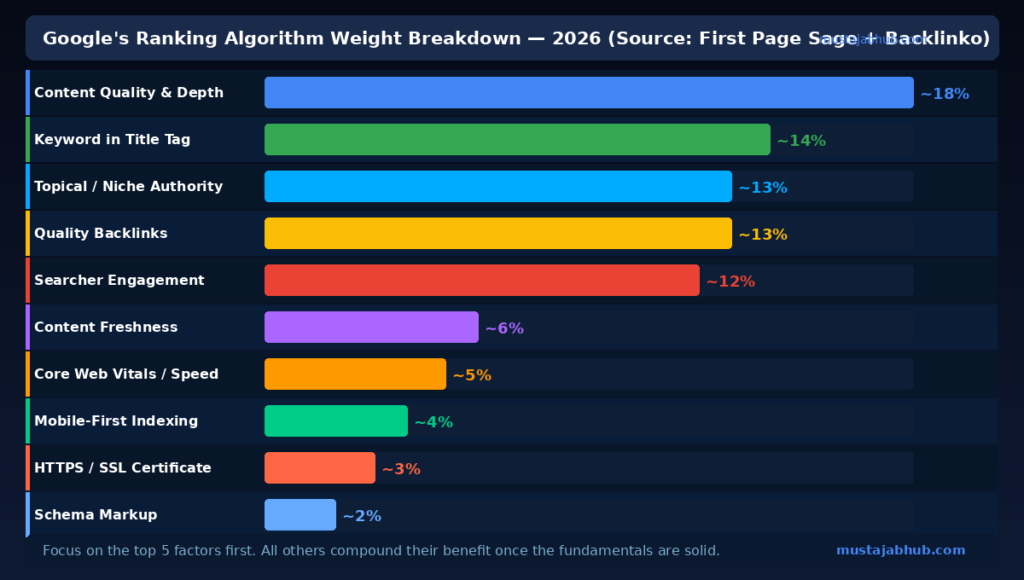
The top Google ranking factors as of 2025 include: keyword in the meta title tag at 14% weight, niche expertise at 13%, backlinks at 13%, searcher engagement at 12%, and content depth as a core signal. Freshness has emerged as the 6th biggest factor — pages updated at least once per year gain an average of 4.6 positions in search results. Niche Pursuits
Here is the full breakdown of what matters most right now:
| Ranking Factor | Weight in Algorithm | What It Means for You |
|---|---|---|
| Content Quality & Depth | ~18% | Your content must fully answer the topic, not just mention keywords |
| Keyword in Title Tag | ~14% | Your focus keyword must appear in your H1 title tag |
| Niche Expertise (Topical Authority) | ~13% | Your whole website should be about related topics — not random |
| Backlinks from Authority Sites | ~13% | Other trusted websites must link to yours |
| Searcher Engagement | ~12% | People must click your result AND stay to read |
| Content Freshness | ~6% | Update old content regularly — outdated pages lose rankings |
| Core Web Vitals (Speed/Performance) | ~5% | LCP, CLS, INP scores must pass Google’s thresholds |
| Mobile-First Indexing | ~4% | Google ranks your mobile version first |
| HTTPS / SSL Certificate | ~3% | Your site must load on HTTPS — not HTTP |
| Schema Markup / Structured Data | ~2% | Helps Google understand your content faster |
| E-E-A-T Signals | Overlay | Experience, Expertise, Authoritativeness, Trust across every page |
Source: First Page Sage algorithm study Q1 2025, Backlinko 200 ranking factors, Google Search Central documentation
How Has Google Ranking Changed From 2020 to 2026 onward?
This is the question most SEO guides skip. Understanding what changed helps you stop doing things that no longer work.
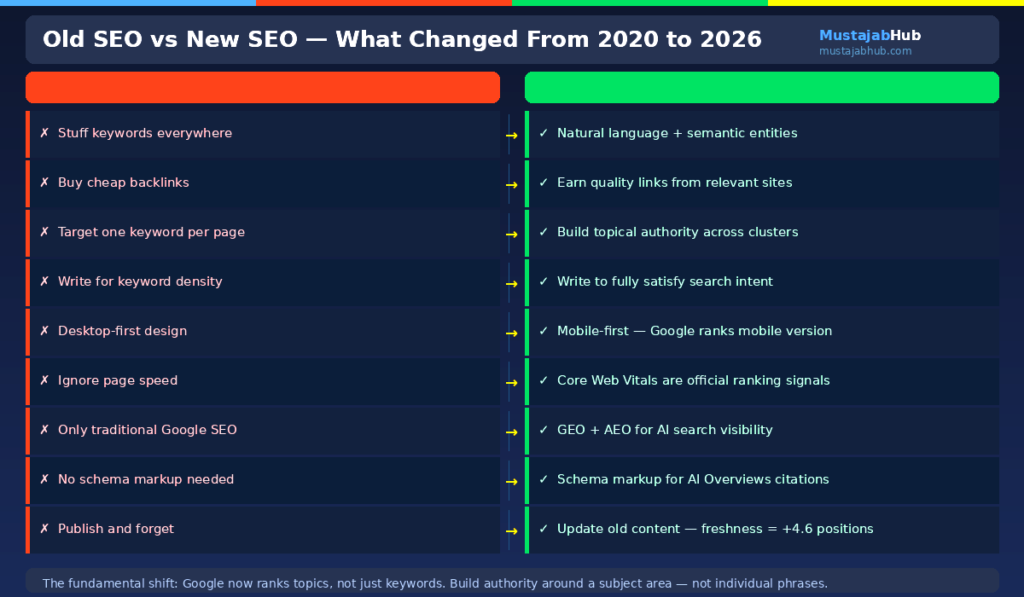
| What Used to Work (2018–2022) | What Works Now (2024–2026) |
|---|---|
| Stuff keywords everywhere | Natural language, semantic entities, topic coverage |
| Buy cheap backlinks | Earn quality backlinks from relevant websites |
| Write any length content | Write content that fully satisfies the search intent |
| Target one keyword per page | Build topical authority across many related posts |
| Desktop-first design | Mobile-first design — Google checks mobile version first |
| Only Google SEO | GEO (Generative Engine Optimization) for AI search results |
| Ignore page speed | Core Web Vitals are now official ranking signals |
| No schema needed | Schema markup improves rankings and AI visibility |
The single biggest shift: Google now understands topics, not just keywords. A page that uses the word “SEO” 50 times but covers nothing else is weaker than a page that covers SEO comprehensively with all related terms, questions, and context.
The winners consistently nail coverage and quality, earn relevant links, deliver excellent page experience, and satisfy users. The absence of an expected signal is the strongest negative factor — it’s better to be present across all core signals than perfect at a few while missing others entirely. Seocasestudy
Step 1: Fix Your Technical SEO First
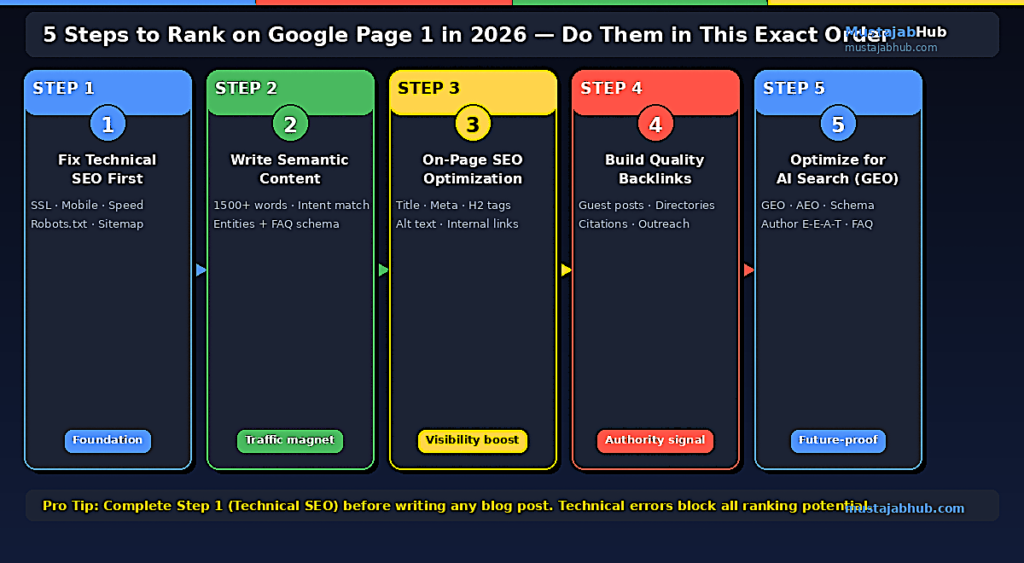
If you don’t know, how to rank on google first page 2026 read this list below carefully, because Google don’t rank you if Google cannot read your website. Technical SEO is the foundation everything else builds on. Think of it as the foundation of a house — without it, nothing else stays standing.
Check these technical elements first:
SSL Certificate and HTTPS — Your website must load on https:// not http://. Google confirmed HTTPS as a ranking signal in 2014 and it remains one today. Check: look for the lock icon in your browser address bar. No lock = no ranking benefit. Free SSL is available from every quality host including Hostinger and WebSouls.
Mobile-Friendly Design — In 2016, Google started giving importance to mobile-first indexing. Google’s index now gives preference to the mobile version of a website when crawling and ranking it. Test your mobile experience at search.google.com/test/mobile-friendly — enter your URL and Google tells you exactly what is broken on mobile. MonetizePros
Core Web Vitals — Three performance scores Google measures on real visitors:
- LCP (Largest Contentful Paint) — main content must load in under 2.5 seconds
- CLS (Cumulative Layout Shift) — page elements must not jump around while loading
- INP (Interaction to Next Paint) — site must respond to clicks in under 200ms
Test these free at pagespeed.web.dev. Fix failing scores with LiteSpeed Cache (free plugin) and Cloudflare CDN (free).
XML Sitemap Submitted — Your sitemap at yourdomain.com/sitemap_index.xml must be submitted in Google Search Console. This tells Google exactly which pages exist on your site and helps crawlers find them faster.
No Broken Links — Broken links are a negative signal. Install the free Broken Link Checker plugin on WordPress and fix every 404 error before doing anything else.
Step 2: Write Content That Answers Real Questions
Here is the honest truth about content in 2026: Google is not looking for the page with the most keywords. It is looking for the page that best satisfies what the searcher actually wants.
This is called search intent. Every search has an intent:
- Informational — “what is technical SEO” (wants to learn)
- Navigational — “mustajabhub.com” (wants a specific site)
- Commercial — “best web developer Pakistan” (comparing options)
- Transactional — “hire SEO expert Pakistan” (ready to buy)
Your content must match the intent of the keyword it targets. A page that tries to sell services to someone who typed an informational question will bounce immediately — and Google sees that bounce and drops your ranking.
How to write content that ranks:
Write a direct answer in your first 50 words. Google AI Overviews and ChatGPT pull from the clearest, most direct answers they find. If your first paragraph answers the question clearly, you have a chance at being cited by AI systems.
Cover the full topic — not just the keyword. Google uses Latent Semantic Indexing Keywords to extract meaning from content. LSI keywords help search engines understand what a page is actually about — not just what word it repeats most. A post about “how to rank on Google” should also naturally include: search engine optimization, organic search results, keyword research, meta title tag, backlinks, crawling and indexing, SERP position, domain authority, ranking factors, Google algorithm, content strategy, on-page SEO, off-page SEO. AgencyAnalytics
Aim for 1,500 to 2,500 words. On average, posts in the first 10 positions on Google search have 1,447 words. However, the perfect length is dependent on the topic — the goal is to cover it completely, not to hit a word count. Serpzilla
Add a Table of Contents, FAQ section with Rank Math FAQ Block, and internal links to related posts on your site.
Step 3: Optimize Every Page With On-Page SEO
On-page SEO is the practice of making each individual page as easy as possible for Google to understand what it is about and who it is for.
The on-page SEO checklist every post needs:
Title Tag (H1): Your focus keyword must appear in your title, ideally in the first 60 characters. The title tag is the single most important on-page SEO element. Google bolds the query terms in results when they match the title, increasing visual prominence and click-through rate. Publift
Meta Description: 150–160 characters. Include your keyword and write it like an advertisement — give people a reason to click your result over the 9 others on page one.
Focus Keyword in First 100 Words: Your primary keyword should appear naturally in your opening paragraph. This confirms to Google what the page is about from the first crawl.
H2 Tags as Questions: Every main section heading should be phrased as a real question people search. Not “About Backlinks” — but “What are backlinks and why do they matter for ranking?”
Image Alt Text: Describe what is in the image AND include your keyword naturally. This helps visually impaired users and gives Google extra context about your page topic.
Internal Links: Every blog post should link to at least 2–3 related posts or service pages on your own website. Internal links spread ranking authority (PageRank) across your site and help Google discover more of your content.
External Links: Link to 1–2 high-authority external sources (Google Search Central, Semrush, Backlinko). This signals that your content is well-researched and connected to trusted sources.
Step 4: Build Backlinks the Right Way
If content is the body of your SEO strategy, backlinks are the heart. They tell Google that other websites trust your content enough to reference it.
The top result in Google typically has significantly more backlinks than positions 2 through 10. Backlinks remain one of the strongest ranking signals because they are difficult to game — getting them requires producing content that others genuinely want to reference. AgencyAnalytics
But not all backlinks are equal. One link from a trusted website in your industry is worth 100 links from random directories.
Free backlink strategies that work for new Pakistani websites:
Guest Posts — Write articles for other websites in your niche. The article links back to your site. This is the most effective free backlink strategy because you control the anchor text and the relevance of the linking site.
Directory Listings — Create profiles on Crunchbase, Clutch.co, Google My Business, LinkedIn, and Pakistani business directories. Each profile with your website URL is a citation — a type of backlink that builds local authority.
Quora and Reddit Answers — Answer questions in your niche thoroughly. At the end of a detailed, helpful answer, reference your blog post naturally. These links are nofollow but they drive real traffic and build brand signals.
Broken Link Building — Find websites in your niche with broken links. Email the owner suggesting your working content as a replacement. This has a response rate of 5–10% and earns genuine contextual backlinks.
Need professional backlink building and SEO implementation for your Pakistani website? MustajabHub’s technical SEO service covers full backlink strategy, on-page optimization, and ranking improvements for small businesses and bloggers.
Step 5: Optimize for AI Search Results (GEO + AEO)
Here is the part of Google ranking in 2026 that most guides completely ignore. Google now shows AI Overviews — AI-generated summaries at the top of search results. ChatGPT, Gemini, and Perplexity are also answering search queries directly, citing sources.
GEO (Generative Engine Optimization) is the practice of making your content attractive for AI systems to cite.
AEO (Answer Engine Optimization) is structuring your content so that AI answer engines pick your specific sentences as direct answers.
To rank in AI results alongside traditional Google rankings, your content needs:
Direct answers in the first 50 words of every section. AI systems pull the clearest, most concise answer first. Do not build up slowly — answer immediately.
Statistics and data every 150–200 words. Content that thoroughly satisfies intent with strong E-E-A-T, endorsed by relevant links, delivered on a fast page experience — and reinforced by brand trust — is what Google rewards in 2026. Seocasestudy
FAQ Schema Markup. Google AI Overviews frequently pull from FAQ schema. Use the Rank Math FAQ Block for every FAQ section — not plain text.
Author Bio with E-E-A-T signals. Add an author bio to every post showing your expertise. Name, location, experience, and credentials. This is Experience-Expertise-Authoritativeness-Trustworthiness — Google’s quality evaluation framework for every page.
How Long Does It Take to Rank on Google’s First Page?
This is the question everyone wants answered, and most SEO guides give vague answers. Here is the honest data:
| Website Status | Content Volume | Target Keywords | Realistic Timeline |
|---|---|---|---|
| New website (0–3 months old) | 10–20 posts | Very low competition | 4–8 months |
| New website (0–3 months old) | 10–20 posts | Medium competition | 8–14 months |
| Established site (1+ year) | 30–50 posts | Low competition | 2–4 months |
| Established site (1+ year) | 30–50 posts | Medium competition | 4–8 months |
| Authority site (3+ years) | 100+ posts | Most keywords | 1–3 months |
The key variable is competition level. Searching “best web developer Pakistan” has fewer people competing than “best web developer” globally. Pakistani and South Asian keywords with local intent consistently rank faster than global competitive terms.
The fastest path to page one: target low-competition, long-tail keywords first. Build traffic and backlinks on those easy rankings. Then use that authority to compete for bigger keywords.
Common Google Ranking Mistakes Pakistani and Asian Websites Makes
Most Pakistani websites make the same avoidable errors that keep them off page one:
Targeting keywords that are too broad. “SEO” is not a keyword you can rank for as a new website. Keyword: “Technical SEO services for small businesses in Rawalpindi” is a keyword you can rank for in 3–4 months.
Skipping Google Search Console. Without Search Console connected, you are driving blindfolded. Search Console shows which keywords people use to find you, which pages have indexing errors, and your Core Web Vitals scores in real data.
Publishing and forgetting. Website pages that are updated at least once per year gain an average of 4.6 positions in search results. Freshness is now the 6th biggest ranking factor in Google’s algorithm. Go back to your old posts every 6 months and update statistics, add new information, and refresh the publish date. Niche Pursuits
No local SEO for local businesses. If you serve Pakistani clients, your Google My Business profile is one of the most powerful ranking tools available to you — and it is completely free. A complete GMB profile with photos, services, and regular posts consistently drives local ranking visibility.
Focusing only on Google and ignoring AI searches. ChatGPT had 100 million users within 2 months of launch. More people every day find information through AI tools rather than traditional search. If your content is not structured for AI citation, you are invisible to a growing audience.
Ready to have a professional SEO audit done on your website? Book a free consultation with MustajabHub and we will identify exactly what is holding your Google ranking back.
Frequently Asked Questions
How long does it take to rank on Google’s first page?
A new website targeting low-competition keywords can reach Google’s first page in 4 to 8 months with consistent publishing and proper SEO. Medium-competition keywords typically take 8 to 14 months. The timeline depends on your content quality, backlink building, technical SEO health, and how competitive your specific niche and target geography are.
What is the most important Google ranking factor in 2026?
Content quality and depth is the single most important ranking factor in 2026, accounting for roughly 18% of the algorithm weight according to First Page Sage’s continuous study. This means content that fully answers the user’s question, covers the topic comprehensively, and demonstrates genuine expertise. Keyword in title tag (14%), niche topical authority (13%), and quality backlinks (13%) are the next most important signals.
Can I rank on Google’s first page for free?
Yes. All the core SEO activities that improve Google ranking are free: publishing quality content, optimizing on-page elements, building backlinks through guest posts and directories, fixing technical SEO issues, setting up Google Search Console, and connecting Cloudflare CDN. (Paid SEO tools like Semrush and Ahrefs help you work faster but are not required to rank.)
Why does my website rank on Google sometimes but not consistently?
Inconsistent rankings are usually caused by: Google testing your page against competitors, insufficient content depth compared to pages already ranking, lack of backlinks from authoritative sources, or Core Web Vitals issues that fluctuate with server load sometimes. Use Google Search Console (GSC) to track your average position over 90 days — trending upward means your SEO is working even if day-to-day fluctuations occur.
What is E-E-A-T and does it affect Google ranking?
E-E-A-T stands for Experience, Expertise, Authoritativeness, & Trustworthiness. It is Google’s quality evaluation framework applied to every page & website. It is not a direct algorithm signal like keywords, but it is an overlay that affects how Google’s quality raters and automated systems evaluate your content’s credibility. Adding an author bio, citing authoritative sources, demonstrating first-hand experience, and earning brand mentions all improve E-E-A-T signals.
How do Google AI Overviews affect traditional rankings?
Google AI Overviews appear above traditional results for many queries — especially informational questions. They pull content from pages that rank in the top 10 but also cite sources outside the top 10. To appear in AI Overviews, your content needs direct answers in the first 50 words of each section, FAQ schema markup, clear heading structure, and strong E-E-A-T signals. Traditional ranking and AI Overview visibility reinforce each other.
Does social media activity improve Google ranking?
Social media signals are not a confirmed direct Google ranking factor. However, social sharing increases content visibility, drives referral traffic, generates brand searches, & also builds high level of awareness that leads to natural backlinks — all of which do affect Google ranking indirectly. Posting your blog content on LinkedIn, Pinterest, and Facebook consistently contributes to the brand signals that Google uses as indirect quality indicators.
For the latest official documentation on how Google’s ranking systems work, visit Google Search Central.